SODP logo

    10 Best Content Analytics Software for Publishers in 2025

    Do you have an eye on top performing content your audience craves and the content analytics tools to help you work smarter, not harder? WordPress claims that its users publish…
    Updated On: January 16, 2026
    Vahe Arabian

    Created By

    Vahe Arabian

    Sreemoyee Bhattacharya

    Fact Checked By

    Sreemoyee Bhattacharya

    Top Picks

    Disclaimer: Our top picks are based on our editors’ independent research, analysis, and/or hands-on testing.

    ★★★★☆

    Impact Hero

    Key Features
    AI-powered analytics with funnel visualization and actionable content conversion insights.
    ★★★★☆

    Affilimate

    Key Features
    Affiliate content optimization with granular link analytics and conversion heatmaps.
    ★★★★☆

    Chartbeat

    Key Features
    Real-time editorial analytics focused on engagement, attention, and content performance.
    ★★★★☆

    NPAW

    Key Features
    Advanced live content analytics with customizable reports and user behavior tracking.
    ★★★★☆

    Parse.ly

    Key Features
    Real-time audience insights, engagement metrics, and intuitive dashboards for publishers.
    ★★★★☆

    Smartocto

    Key Features
    Predictive analytics and AI-guided editorial recommendations for newsroom optimization.
    ★★★★☆

    Metrics for News

    Key Features
    Journalism-centric analytics with AI-powered tagging and custom scoring.
    ★★★☆

    News Consumer Insights

    Key Features
    Google-powered audience segmentation and engagement analysis for publishers.
    ★★★☆

    IO Technologies

    Key Features
    Real-time, user-friendly analytics platform for editorial teams and content optimization.
    ★★★☆

    Xamsor

    Key Features
    Content audit and SEO analytics with backlink tracking and actionable optimization guidance.

    Ask ChatGPT

    Do you have an eye on top performing content your audience craves and the content analytics tools to help you work smarter, not harder? WordPress claims that its users publish about 70 million new posts every month. With almost millions of blogs posted every day, publishers need more than just quality content to stand out. Content analytics help publishers gain valuable insights into how their content is performing and what type of content resonates most with their audience. 

    This article will define content analytics tools, discuss their importance for publishers, and review the best content analytics software solutions available in 2025.

    What Is Content Analytics Software?

    Content analytics software is a toolset that helps teams assess how readers interact with their published material. 

    According to Grand View Research, the global content analytics market size was valued at USD 9.31 billion in 2024 and is predicted to grow at an annual rate of 18.9% from 2025 to 2030.

    Beyond user behavior, content analytics helps publishers understand reader preferences, recognize trends, and refine their content marketing efforts accordingly.

    How Does Content Analytics Software Work?

    A content analytics platform enables publishers to accurately measure the impact of their content and make informed, data-driven decisions. Apart from views or feedback, it helps publishers uncover patterns in reader behavior and discover best performing formats.

    Through natural language queries, trend analysis, contextual discovery, and predictive analytics, it can identify distinct patterns. For instance, it may reveal that readers are more engaged with content posted on Tuesday mornings, or that “How-to” articles receive more shares than other types.

    Beyond identifying current digital publishing trends, content analytics software also uses predictive analytics to anticipate future patterns. This enables publishers to make informed decisions about choosing the best topics, optimal length, and the most effective publication time.

    Why Should Publishers Use Content Analytics Software?

    1. Increase Reader Engagement

    Content analytics software must show how users interact with content, such as time on page or engagement levels, guiding publishers to personalize the content strategy accordingly.

    2. Improve SERP Ranking

    It must analyze the performance of specific keywords and quality backlinking, empowering publishers to refine their SEO strategies.

    3. Conduct Competitor Analysis

    These tools help publishers keep a close eye on their competitors, identify content gaps, track trending topics, and stay ahead of the curve.

    4. Measure Content Performance

    Content analytics software helps the team understand how changes impact the business, especially for evergreen content. Tracking ad revenue and subscriptions enables publishers to measure their return on investment (ROI). 

    Essential Criteria for Selecting an Effective Content Analytics Software for Publishers

    1. Content Performance Metrics

    A robust analytics platform must track views, clicks, conversions, and shares, which help publishers gauge conversion metrics.

    2. Audience Insights

    It must provide demographic and behavioral data such as age, location, device use, new vs. returning visitors, and traffic source analysis.

    3. Content Quality Metrics

    It should assess content health scores by evaluating key metrics such as readability, search engine optimization, keyword performance, and overall search visibility. 

    4. Monetization Metrics

    With these tools, publishers should track click view returns, ad performance, and subscriber behavior. 

    5. Technical Performance

    Be it analyzing load times, mobile responsiveness, or usability across devices, it should track all performance issues. 

    6. Competitive Analysis

    It should enable publishers to compare their performance with that of their competitors, discover best practices, and establish benchmarks.

    7. Predictive and Prescriptive Analytics

    Apart from leveraging historical data, it must offer automated suggestions like tweaking headlines, refining SEO strategies, and optimizing CTAs.

    8. Data Integration and Reporting

    It must provide customizable dashboards, real-time access to critical data, automated reports, and robust API integrations with Google Analytics and CMS platforms.

    9. Attribution and Conversion Tracking

    It must guide publishers in mapping user journeys and understanding which content drives the best results.

    10. Privacy and Compliance

    The software should comply with the GDPR and CCPA, ensuring the secure handling of user data.

    10 Best Content Analytics Software for Publishers

    Here is how we rated each platform for different parameters out of 5:

    Tool/company Content Performance Metrics Audience Insights Content Quality Metrics Content Efficiency and Workflow Metrics Monetization Metrics Technical Performance User Interaction with Content Comparative Analysis Predictive and Prescriptive Analytics Data Integration and Reporting Attribution and Conversion Tracking Privacy and Compliance Score
    Impact Hero 4.5 4.3 4.6 4 3.8 4.2 3.5 4.4 4.5 4.7 4 4.8 4.3
    Affilimate 4.4 3.8 4.2 3.5 4.8 3.9 4 4.1 3.7 4.5 4.6 4.3 4.2
    Chartbeat 4.5 4 4 4 4 4.3 4 4 4 4.5 4 4.5 4.2
    NPAW 4.2 4 3.8 3.5 4.5 4.7 3.7 4 4.3 4.6 3.9 4.8 4.2
    Parse.ly 4.5 4.3 4 4 3.8 4.3 4 4.1 4.2 4.7 4 4.5 4.1
    Smartocto 4.2 4.1 4.3 3.9 3.5 4 3.8 4 4.4 4.6 4.1 4.5 4.1
    Metrics for News 4.5 4.2 4.2 4 3.8 4 4 4.2 3.8 4.5 4.0 4.5 4.1
    News Consumer Insights 4 4.5 3.5 3 3 4.5 3.8 4 3.5 4.2 4 4.5 3.9
    IO Technologies 3.8 3.5 4 3.7 3 4 3.5 4.2 3.8 4 3.5 4.3 3.8
    Xamsor 3.8 3.5 3.7 3.5 3 4 3.2 3 3.5 4 3.5 4.2 3.5

    Navigating the plethora of content analytics software options can be a challenge. To help streamline the decision-making process, we’ve curated a list of the twelve best content analytics tools for publishers in 2025. Let’s dive in.

    1

    Impact Hero

    ★ 4.3

    Impact Hero

    Impact Hero by Semrush is one of the leading AI-powered content analytics software for brands that want to add a conversion-centric approach to content strategy. Using a Markov chain model, it traces various stages of the audience’s awareness, consideration, decision, and conversion. The intuitive dashboard helps the team understand which content is generating sales and contributing to the marketing funnel. 

    Our rating: ★★★★☆ 4.3

    Key features

    • Beyond traffic, it involves unique metrics, such as Impact Score, Engagement Score, and Page Potential.
    • Content Funnel Visualization highlights the performance of content at each stage.
    • AI-driven tips highlight which content pieces should be repurposed or promoted more.

    Pros

    • Offers actionable insights on how content drives leads and conversions. 
    • Perfect for small to mid-sized content teams who lack an expert analyst but still want data-driven insights.
    • Supports smarter resource allocation

    Cons

    • Only conducts content performance on the site. Does not track data on social media, or third-party sites.
    • Companies with non-linear funnels might find the tool restrictive as the customer journey is fixed.

    Content Performance Metrics
    4.5

    Audience Insights
    4.3

    Content Quality Metrics
    4.6

    Content Efficiency and Workflow Metrics
    4

    Monetization Metrics
    3.8

    Technical Performance
    4.2

    User Interaction with Content
    3.5

    Comparative Analysis
    4.4

    Predictive and Prescriptive Analytics
    4.5

    Data Integration and Reporting
    4.7

    Attribution and Conversion Tracking
    4

    Privacy and Compliance
    4.8

    0
    0.5
    1
    1.5
    2
    2.5
    3
    3.5
    4
    4.5
    5

    2

    Affilimate

    ★ 4.2

    Affilimate

    Affilimate is a powerful content analytics and affiliate optimization platform that fuels a two to tenfold growth in revenue per article. It helps publishers connect to their networks and fine-tune existing commerce content to reach maximum ROI. It is used by reputed names like Business Insider, a360 Media, and MarketingLogIQ.

    Our rating: ★★★★☆ 4.2

    Key features

    • Provides in-depth insights on affiliate links and CTAs within articles.
    • Through conversion heat maps, it highlights where users engage on the page.
    • Tracks performance through analysis of pages, links, elements, traffic sources, and UTM tags.
    • Breaks down content performance and tracks trending and declining posts.

    Pros

    • Extremely granular analytics and strong attribution tools.  
    • Integrates and collects data from 100+ affiliate platforms
    • Monitors content changes and their effect on CTR, EPC, and RPM.

    Cons

    • Requires manual import of Amazon affiliate reports. ​
    • Offers less flexibility in customizing dashboards.

    Content Performance Metrics
    4.4

    Audience Insights
    3.8

    Content Quality Metrics
    4.2

    Content Efficiency and Workflow Metrics
    3.5

    Monetization Metrics
    4.8

    Technical Performance
    3.9

    User Interaction with Content
    4

    Comparative Analysis
    4.1

    Predictive and Prescriptive Analytics
    3.7

    Data Integration and Reporting
    4.5

    Attribution and Conversion Tracking
    4.6

    Privacy and Compliance
    4.3

    0
    0.5
    1
    1.5
    2
    2.5
    3
    3.5
    4
    4.5
    5

    3

    Chartbeat

    ★ 4.2

    Chartbeat

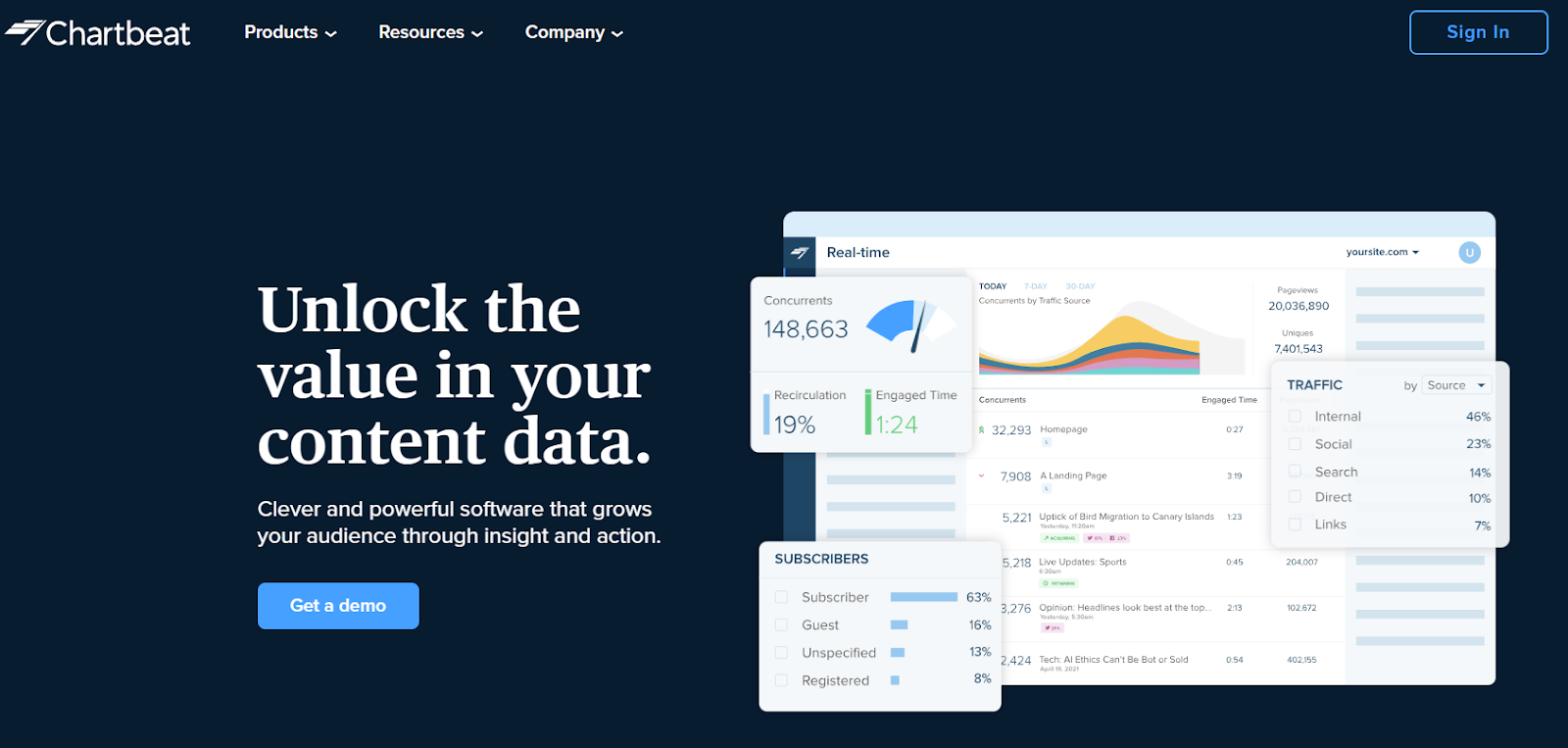
    Chartbeat is a real-time content analytics platform that guides newsrooms to make effective editorial decisions through real-time and historical dashboards. With robust optimization tools, it enhances reach, retention, and reader engagement. Trusted by 5,000 media brands across 70+ countries, it is used by The New York Times, The Salt Lake Tribune, and The Washington Post.

    Our rating: ★★★★☆ 4.2

    Key features

    • Beyond general web metrics, it focuses on editorial key performance indicators, such as attention time, recirculation, and conversions.
    • Allows in-depth headline testing and performance tracking across multiple data sources.
    • Keeps teams informed through instant website traffic spike alerts and scheduled performance reports.

    Pros:

    • Real-time monitoring of page views, scroll depth, and active readers.
    • User-friendly dashboard highlighting top-performing stories and content placement.
    • Integrates seamlessly with popular CMSs and platforms like AMP, Apple News, and Facebook Instant Articles.

    Cons:

    • Entry plans might seem expensive for smaller publications.
    • Does not have a mobile app.

    Content Performance Metrics
    4.5

    Audience Insights
    4

    Content Quality Metrics
    4

    Content Efficiency and Workflow Metrics
    4

    Monetization Metrics
    4

    Technical Performance
    4.3

    User Interaction with Content
    4

    Comparative Analysis
    4

    Predictive and Prescriptive Analytics
    4

    Data Integration and Reporting
    4.5

    Attribution and Conversion Tracking
    4

    Privacy and Compliance
    4.5

    0
    0.5
    1
    1.5
    2
    2.5
    3
    3.5
    4
    4.5
    5

    4

    NPAW

    ★ 4.2

    NPAW

    NPAW empowers publishers with advanced content analytics that enable them to understand how readers interact with articles and digital assets across various platforms. Focused on user behavior, live performance tracking, and automated content tagging, it helps teams identify underperforming stories and offers customizable reports that strengthen content marketing strategies. It is trusted by clients like Fox, AMC, and Equidia.

    Our rating: ★★★★☆ 4.2

    Key features

    • Each article page features a Heads-Up Display (HUD) that reveals live analytics, including clicks, scroll depth, and performance ranking.
    • Real-time testing for headlines, subtitles, and images.
    • Dashboards track every stage of customer acquisition, engagement, and retention.

        Pros

    • Seamless integration through browser extensions and WordPress plugins.
    • Analyzes audience behaviour according to device type and tailors distinguished content strategies.

    Cons

    • Does not directly support keyword research or search engine optimization metrics.
    • Not suitable for multi-channel or off-site performance tracking.

    Content Performance Metrics
    4.2

    Audience Insights
    4

    Content Quality Metrics
    3.8

    Content Efficiency and Workflow Metrics
    3.5

    Monetization Metrics
    4.5

    Technical Performance
    4.7

    User Interaction with Content
    3.7

    Comparative Analysis
    4

    Predictive and Prescriptive Analytics
    4.3

    Data Integration and Reporting
    4.6

    Attribution and Conversion Tracking
    3.9

    Privacy and Compliance
    4.8

    0
    0.5
    1
    1.5
    2
    2.5
    3
    3.5
    4
    4.5
    5

    5

    Parse.ly

    ★ 4.2

    Parse.ly

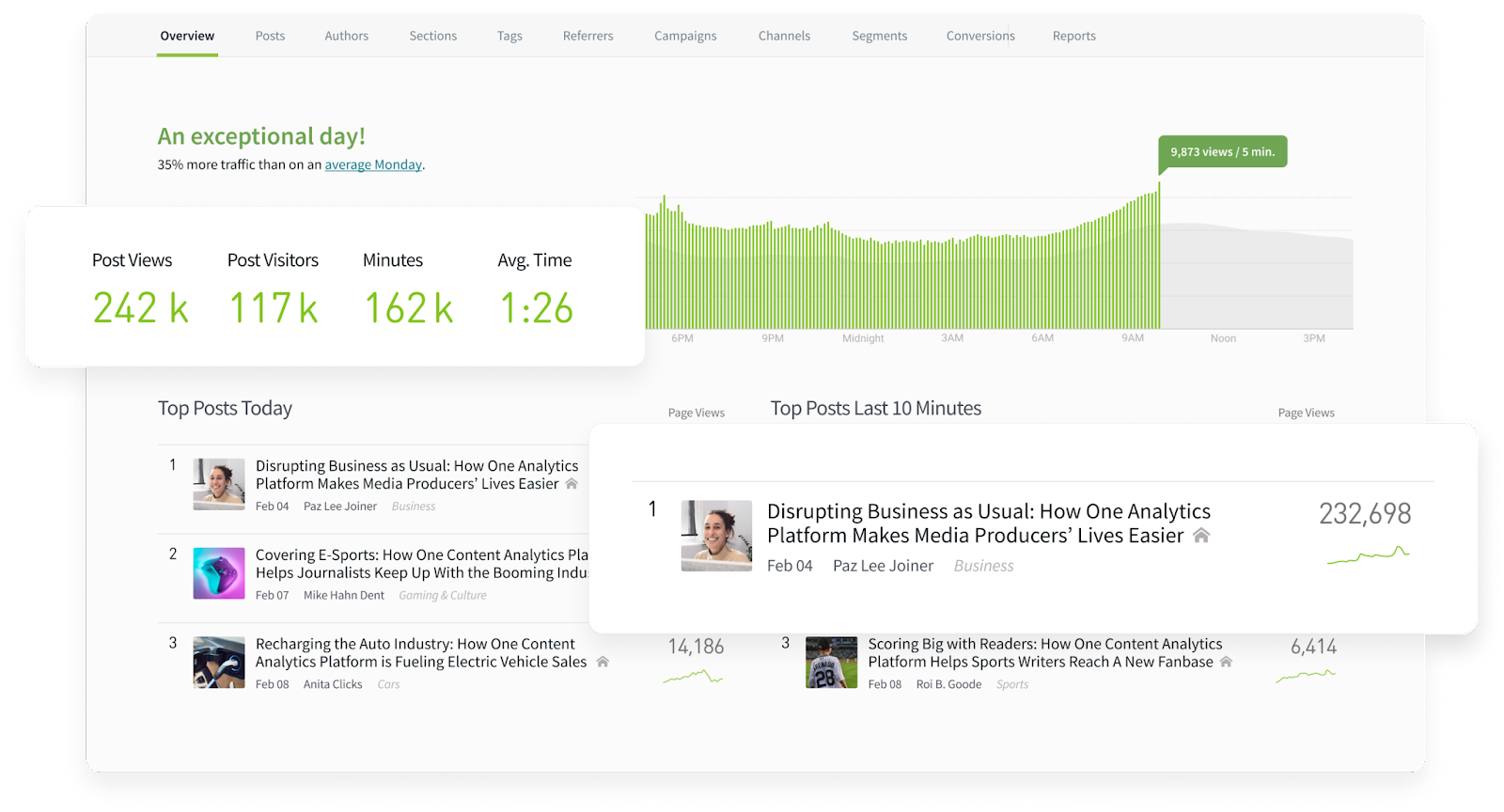
    Parse.ly is a leading content analytics platform helping publishers engage with their target audiences more effectively. It allows publishers to analyze traffic from social media platforms and recalibrate digital marketing efforts. Offering real-time analytics, intuitive dashboards, and strong attribution tools, it helps teams uncover the factors behind content success. It is trusted by The Wall Street Journal, NBC Universal, and Bloomberg. 

    Our rating: ★★★★☆ 4.1

    Key features

    • Beyond pageviews, it offers real engagement time, recirculation rate, and social referrals.
    • Content Conversion Engine analyzes the type of content that leads to essential actions, like sign-ups, downloads, or sales.
    • Allows flexible audience segmentation without needing SQL.

    Pros

    • Fast onboarding, scheduled reports, and easier for non-technical teams.
    • Operates seamlessly with WordPress VIP and features a flexible API for developers.
    • Intuitive & accessible dashboards.

    Cons

    • The platform lacks advanced SEO auditing or A/B testing.
    • Restricted view via UI.
    • Pricing is more suitable for enterprise-level companies.

    Content Performance Metrics
    4.5

    Audience Insights
    4.3

    Content Quality Metrics
    4

    Content Efficiency and Workflow Metrics
    4

    Monetization Metrics
    3.8

    Technical Performance
    4.3

    User Interaction with Content
    4

    Comparative Analysis
    4.1

    Predictive and Prescriptive Analytics
    4.2

    Data Integration and Reporting
    4.7

    Attribution and Conversion Tracking
    4

    Privacy and Compliance
    4.5

    0
    0.5
    1
    1.5
    2
    2.5
    3
    3.5
    4
    4.5
    5

    6

    Smartocto

    ★ 4.1

    Smartocto

    Smartocto is an editorial-first content analytics tool that combines historical data, AI guidance, and test-driven optimization. Apart from tracking performance data, it offers insights on content to optimize, promote, and boost audience impact. Serving more than 300 newsrooms and media companies across 40 countries, it empowers newsrooms to refine their content marketing strategy. Notable clients include DPG Media and DailyCoin.
    Our rating: ★★★★☆ 4.1

    Key features

    • Smartify provides AI-powered alerts that guide editors to take practical steps to boost engagement. 
    • Story Value Engine helps teams focus on content that drives maximum conversions.
    • Multi-channel tracking across the web, mobile, newsletters, and social media platforms.
    • Real-time dashboards are designed for newsrooms that monitor live performance, audience behavior, and alerts.

    Pros

    • Beyond showing data, Smartocto provides that extra nudge that helps teams take practical steps to boost performance.
    • Be it Smartify or Story Value, every feature is designed for fast-paced editorial environments.
    • The User Needs Model helps publishers prioritize audience demands.

    Cons

    • Intermittent crashes while viewing live data.  
    • Teams may require training to utilise features such as Tentacles or the User Needs Model.

    Content Performance Metrics
    4.2

    Audience Insights
    4.1

    Content Quality Metrics
    4.3

    Content Efficiency and Workflow Metrics
    3.9

    Monetization Metrics
    3.5

    Technical Performance
    4

    User Interaction with Content
    3.8

    Comparative Analysis
    4

    Predictive and Prescriptive Analytics
    4.4

    Data Integration and Reporting
    4.6

    Attribution and Conversion Tracking
    4.1

    Privacy and Compliance
    4.5

    0
    0.5
    1
    1.5
    2
    2.5
    3
    3.5
    4
    4.5
    5

    7

    Metrics for News

    ★ 4.1

    Metrics for News

    Metrics for News is a top journalism-centric analytics platform developed by the American Press Institute. A unique combination of engagement data with AI-powered tagging, custom scoring, and strategic dashboards is designed to support mission-driven journalism. Leading media organizations, including the Buffalo News, use this tool. 

    Our rating: ★★★★☆ 4.1

    Key features

    • Gathers data from multiple sources like Google Analytics, social media, RSS feed and organizes it for customized insights.
    • AI-Powered content tagging classifies stories on the basis of topic, author, format, and editorial audience.
    • Newsroom Priority Mapping helps teams tag individual stories to the organizational mission.

    Pros

    • The percentile scoring offers a more accurate view of the performance of a particular content piece.
    • Does not demand expertise in analytics.
    • The grants and special non-profit pricing make it an ideal choice for news agencies with limited budgets.

    Cons

    • Navigating advanced custom reports can be challenging if the team is not well-versed in tags and metrics.
    • The system of auto-tagging becomes more accurate only after 1,000 articles are processed.

    Content Performance Metrics
    4.5

    Audience Insights
    4.2

    Content Quality Metrics
    4.2

    Content Efficiency and Workflow Metrics
    4

    Monetization Metrics
    3.8

    Technical Performance
    4

    User Interaction with Content
    4

    Comparative Analysis
    4.2

    Predictive and Prescriptive Analytics
    3.8

    Data Integration and Reporting
    4.5

    Attribution and Conversion Tracking
    4

    Privacy and Compliance
    4.5

    0
    0.5
    1
    1.5
    2
    2.5
    3
    3.5
    4
    4.5
    5

    8

    News Consumer Insights

    ★ 3.9

    News Consumer Insights

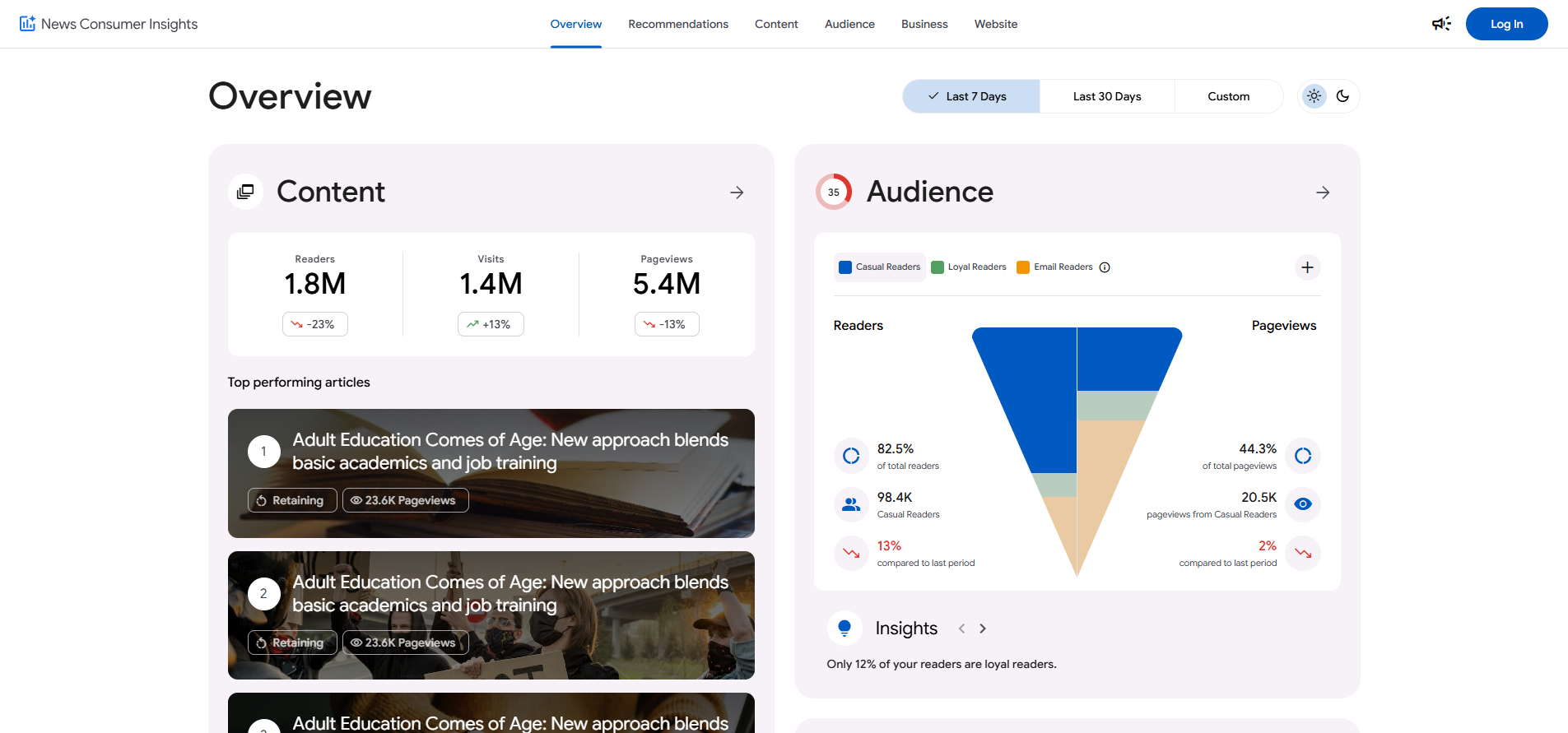
    News Consumer Insights (NCI) is an AI-powered analytics tool that collects data derived from Google Analytics. Offering the perfect blend of editorial insight, audience segmentation, traffic sources and guidance on revenue optimization, it helps news publishers boost subscriptions, loyalty, and engagement. Público, one of Portugal’s leading news publishers, used this tool and experienced 144% growth in monthly registrations.

    Our rating: ★★★☆ 3.9

    Key features

    • The Automatic Audience Grouping classifies readers into various groups, such as Casual, Loyal, Brand-Loving, and Subscribers.
    • Integration with Google Analytics, Search Console, and Ad Tools provides a holistic view in one dashboard.
    • Thoroughly analyzes site health, core web vitals, mobile experience, search engine optimization, and accessibility.

    Pros:

    • By combining user behavior, technical site metrics, and monetization information, it provides a 360 degree editorial and business perspective.
    • The Google News Initiative has made this tool available free of charge to publishers. 

    Cons:

    • Dependent on Google Analytics Setup.
    • Although it has updated insights on its dashboard, it does not offer minute-by-minute tracking.

    Content Performance Metrics
    4

    Audience Insights
    4.5

    Content Quality Metrics
    3.5

    Content Efficiency and Workflow Metrics
    3

    Monetization Metrics
    3

    Technical Performance
    4.5

    User Interaction with Content
    3.8

    Comparative Analysis
    4

    Predictive and Prescriptive Analytics
    3.5

    Data Integration and Reporting
    4.2

    Attribution and Conversion Tracking
    4

    Privacy and Compliance
    4.5

    0
    0.5
    1
    1.5
    2
    2.5
    3
    3.5
    4
    4.5
    5

    9

    IO Technologies

    ★ 3.8

    IO Technologies

    IO Technologies stands out as a content analytics software tailor-made for digital publishers.  Providing real-time data and a user-friendly editorial dashboard, it helps editorial teams optimize evergreen content, build a loyal readership, and generate more revenue. Reputable media outlets, including DMG Media, IDG Communications, and Kurier, trust it. 

    Our rating: ★★★☆ 3.8

    Key features

    • Real-time reporting and anomaly detection enable teams to make informed, agile editorial decisions.
    • Optimizes homepage CTR that helps in discovering the top-performing stories and headlines.
    • Builds audience loyalty and drives subscriptions by tracking time-on-page, session depth, and readability funnels. 

    Pros:

    • Offers a user-friendly interface with personalized dashboards.
    • Allows multi-platform tracking.
    • Provides customer reporting for various roles.

    Cons:

    • Since it is designed for digital publishers, it is less useful for e-commerce and SaaS.
    • Does not offer comprehensive tracking for site speed.
    • Lacks advanced customization options, unlike platforms like Google Analytics.

    Content Performance Metrics
    3.8

    Audience Insights
    3.5

    Content Quality Metrics
    4

    Content Efficiency and Workflow Metrics
    3.7

    Monetization Metrics
    3

    Technical Performance
    4

    User Interaction with Content
    3.5

    Comparative Analysis
    4.2

    Predictive and Prescriptive Analytics
    3.8

    Data Integration and Reporting
    4

    Attribution and Conversion Tracking
    3.5

    Privacy and Compliance
    4.3

    0
    0.5
    1
    1.5
    2
    2.5
    3
    3.5
    4
    4.5
    5

    10

    Xamsor

    ★ 3.5

    Xamsor

    Xamsor is an all-in-one content audit and analytics resource designed to assist publishers in the process of auditing, verifying, and evaluating backlinks. Connecting seamlessly with Google Analytics and Google Search Console, it tracks user behavior, traffic trends, and other metrics. Offering the best of SEO data with editorial guidance in customizable reports, it helps organizations make data-driven decisions that drive measurable growth.

    Our rating: ★★★☆ 3.5

    Key features

    • Real-time backlink checker eliminates the need to log in.
    • Multi-source domain authority metrics provide a comprehensive view of your SEO strength.
    • Provides actionable content optimization guidance, such as updating, deleting, consolidating, or expanding.

    Pros:

    • The cross-platform authority comparison saves time on switching tools.
    • Through data-backed recommendations, it eliminates hours of manual content auditing.

    Cons:

    •  Beyond backlink analysis, it does not offer broader SEO features.
    •  Lacks the ability to track backlink history or changes over time.

    Content Performance Metrics
    3.8

    Audience Insights
    3.5

    Content Quality Metrics
    3.7

    Content Efficiency and Workflow Metrics
    3.5

    Monetization Metrics
    3

    Technical Performance
    4

    User Interaction with Content
    3.2

    Comparative Analysis
    3

    Predictive and Prescriptive Analytics
    3.5

    Data Integration and Reporting
    4

    Attribution and Conversion Tracking
    3.5

    Privacy and Compliance
    0

    0
    0.5
    1
    1.5
    2
    2.5
    3
    3.5
    4
    4.5
    5

    Final Thoughts

    While every analytics tool offers its strengths, the best choice is the one that empowers publishers to make faster, smarter, and more goal-driven decisions. When analytics align with business priorities, they become a competitive advantage. Publishers gain clearer visibility into what’s working, why it’s working, and how to scale that success across content channels.

    And finally, remember: while analytics provide valuable direction, compelling content, supported by thoughtful marketing, is still the foundation of a successful publishing strategy.