SODP logo

    14 Best Media Monitoring Tools in 2026

    Media monitoring is a vital part of any digital publisher’s path to success. It is necessary to hear stories as they happen, track the competition and remain alert to any…
    Updated On: January 16, 2026
    Vahe Arabian

    Created By

    Vahe Arabian

    Vahe Arabian

    Fact Checked By

    Vahe Arabian

    Samuel Fatola

    Edited By

    Samuel Fatola

    Top Picks

    Disclaimer: Our top picks are based on our editors’ independent research, analysis, and/or hands-on testing.

    ★★★★☆

    AlphaMetricx

    Key Features
    AI-powered search, PR impact scoring, real-time insights, custom dashboards, auto newsletters, and competitor tracking.
    ★★★★☆

    Brandwatch

    Key Features
    Comprehensive social listening with advanced analytics, AI-powered insights, and trend identification.
    ★★★★☆

    Brand24

    Key Features
    Affordable media monitoring with real-time alerts, sentiment analysis, and influencer tracking.
    ★★★★☆

    Meltwater

    Key Features
    Integrated media intelligence platform combining media monitoring, social listening, and PR distribution.
    ★★★★☆

    Agility PR Solutions

    Key Features
    Media database and monitoring tool designed for PR professionals with targeted media outreach.
    ★★★★☆

    CISION

    Key Features
    PR and marketing platform with media monitoring, distribution, and analytics for comprehensive campaign management.
    ★★★★☆

    Dataminr

    Key Features
    Real-time event detection and breaking news alerts based on social media and public data streams.
    ★★★★☆

    KeyTrends

    Key Features
    AI-driven social listening and analytics platform focused on identifying key trends and insights from conversations.
    ★★★★☆

    Muck Rack

    Key Features
    Platform for finding journalists, building media lists, and monitoring news coverage.
    ★★★★☆

    Google Trends

    Key Features
    Free tool from Google that shows the popularity of search terms over time.
    ★★★★☆

    Isentia

    Key Features
    Media intelligence solutions including monitoring, analysis, and reporting across various channels.
    ★★★★☆

    Determ

    Key Features
    Provides cloud-based enterprise governance, risk, and compliance (GRC) and contract management solutions.
    ★★★★☆

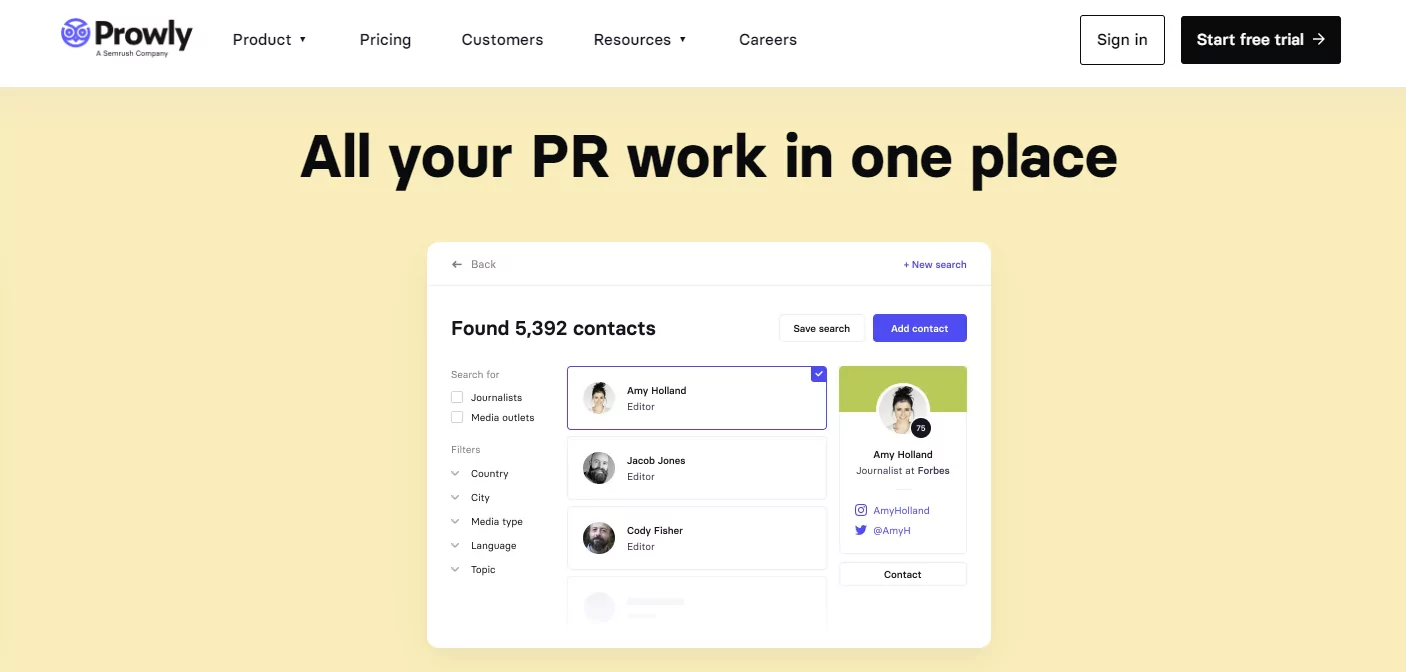
    Prowly

    Key Features
    PR software for finding media contacts, sending personalized pitches, and tracking email campaigns.
    ★★★★☆

    News Exposure

    Key Features
    Provides press release distribution services to news outlets and online media.

    Ask ChatGPT

    Media monitoring is a vital part of any digital publisher’s path to success. It is necessary to hear stories as they happen, track the competition and remain alert to any oncoming crises — and the best media monitoring software and news monitoring tools automate all of this.

    While the practice of media monitoring has existed for more than a century, the introduction of internet news and online social networks has seen the practice undergo radical new shifts in innovation. This is where media monitoring tools enter, leveraging AI technology to gain insight into trends and public opinion across billions of discussions on a daily basis.

    These tools are also becoming ever more popular, with the expected global market share to more than triple from $3.96 billion in 2022 to $11.54 billion by 2029. As digital media sees its popularity increase over traditional media, media monitoring tool options have also climbed.

    But with so many choices out there, how do publishers ensure they choose the best one for their company? To help alleviate decision paralysis, we’ve drawn together a list of the 13 best media monitoring tools.

    Why Is Media Monitoring Important? 

    Media monitoring allows publishers to identify upcoming trends, compare their content to their competitors and alert them to any emerging crises. In the information age, being the first to act can secure more viewers as well as help head off potential reputational harm.

    News monitoring is crucial for staying updated with relevant topics and brand mentions, protecting a brand’s reputation, and understanding public sentiment.

    Media monitoring has a rich history. Emerging in the industrial era as print became more accessible to the general public, artists would monitor the press for mentions. Since then, media monitoring has continued to be a valuable resource for organizations looking to review their image and see how they stack up against their competitors.

    Gone are the days of copying, cutting and pasting print articles, with software having now taken over. The process has become automated and streamlined to suit a far more competitive and timely industry.

    The continuing media evolution has made software tools essential for news and brand publishers alike. For example, the standardization of the 24-hour news cycle meant that news outlets looking to update around the clock needed information around the clock.

    Likewise, the radical shift in the general public’s power to damage brand reputation has necessitated greater media monitoring. Social media channels have created opportunities for the public to directly communicate with organizations — but that doesn’t mean all interactions are positive. The 2012 #McDStories are a prime example of this.

    Media monitoring tools play an important role in mitigating the effects of public relations (PR) disasters. They allow publishers and marketers to rapidly react to crisis situations by keeping them informed in an ever-changing environment.

    3 Types of Media Monitoring Tools

    While each media monitoring tool overlaps with one another in terms of capabilities, there are some broad differences in terms of functionality. A media monitoring solution can help track efforts, make mid-campaign adjustments, and measure against business objectives. The software tends to lean towards one of three categories:

    • Public relations
    • News gathering
    • General trend analysis

    PR Tools

    One of the consequences of the invention of social media, online forums and the 24-hour news cycle, is that news now spreads incredibly quickly. Company crises now spread like wildfire.

    PR media monitoring can provide a heads up to oncoming disasters, with the tools generally focusing on online social spaces. They come equipped with the ability to measure sentiment, that is the negative or positive emotions attached to messages. Media monitoring providers offer integrated communications platforms and advanced features to support PR efforts.

    News Monitoring Tools

    News-gathering tools are generally focused on detecting emerging news trends or events as quickly as possible. They generally monitor for keywords, or a general area, and alert a publisher or content creator to any potential trends. A news monitoring tool can track and analyze news mentions across various channels to detect specific information.

    Some even go a step further, such as Help A Reporter Out platform, which connects journalists to useful sources for their articles.

    General Trend Analysis

    The more general media monitoring tools are usually the cheapest or sometimes just outright free. They generally have limited capabilities, have less automation and tend not to fill any niches.

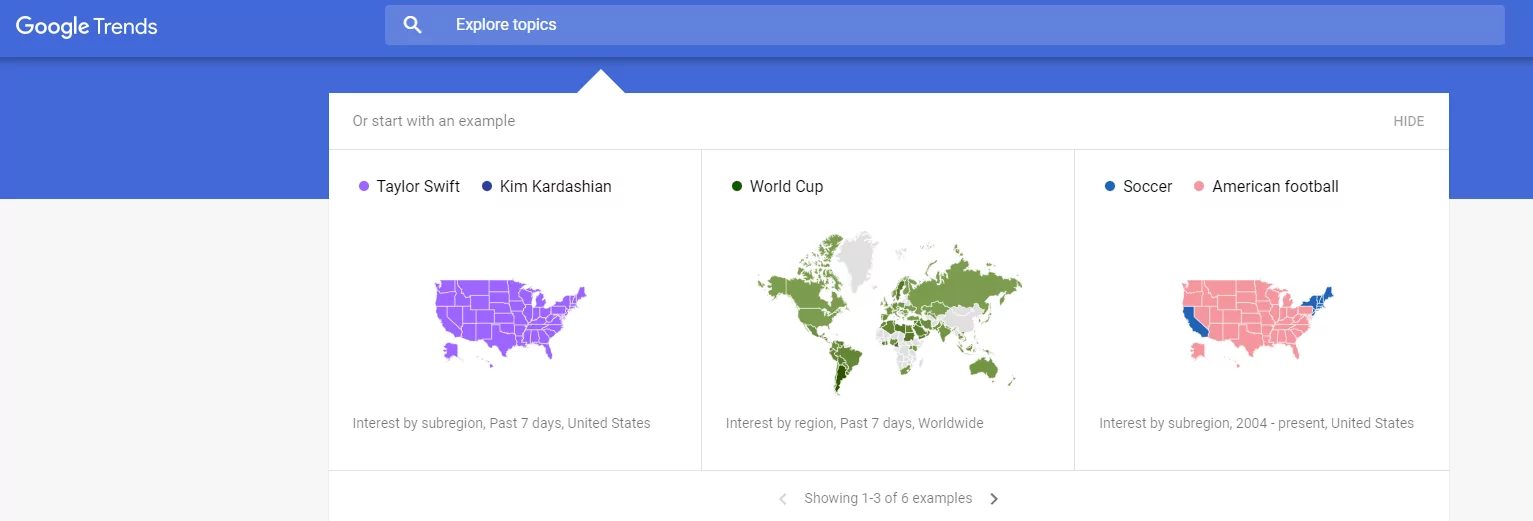
    Take, for example, Google Trends and Google Alerts. These tools are simple to use, free and proficient at what they do. However, they don’t provide sentiment analysis.

    Essential Criteria for Selecting an Effective Media Monitoring Tool

    Evaluating media monitoring tools is crucial for publishers seeking to effectively track and analyze the impact of their content. Here’s a summary of key criteria to consider:

    1. Coverage and Reach

    Ensure the solution monitors a comprehensive range of media types, including traditional outlets (TV, radio, print), online news, blogs, podcasts, and social media platforms. Verify its ability to track media from regions or countries pertinent to your target audience. Confirm support for multiple languages, especially if catering to an international or multicultural readership.

    2. Accuracy and Relevance

    Evaluate how effectively the solution filters out irrelevant content, delivering only pertinent mentions. Assess the accuracy of sentiment analysis in determining positive, negative, or neutral tones in coverage. Check if users can set specific criteria, such as keywords, topics, or competitors, to refine monitoring.

    3. Real-Time Monitoring

    Determine if the solution offers real-time alerts for breaking news or mentions. Look for customizable alert preferences, such as email, SMS, or dashboard notifications. Consider how quickly the solution processes and delivers new content.

    4. Data Analysis and Reporting

    Seek customizable dashboards that provide actionable insights, such as share of voice and engagement metrics. Ensure access to historical data for trend analysis and performance tracking. Verify the ability to create custom reports focusing on specific metrics. Check for various data export formats like PDF, CSV, or Excel for further analysis.

    5. Engagement Metrics

    Assess how well the solution tracks social media engagement metrics, including shares, comments, and likes. Determine if it provides data on the reach and potential audience size of mentions. Check if the solution can monitor mentions by key influencers or media personalities relevant to your brand.

    6. Competitive Intelligence

    Ensure the solution allows tracking of competitors’ mentions and media coverage. Look for features that enable comparison of your coverage to competitors to assess share of voice or media presence.
    7. User Experience and Interface

    Evaluate the platform’s intuitiveness and ease of navigation for all user levels. Check how easily users can customize dashboards, alert settings, and reports. Ensure the solution provides training, tutorials, and responsive customer support.

    8. Integration with Other Tools

    Verify if the monitoring solution integrates with your content management system for seamless data sharing. Assess compatibility with other tools, such as analytics platforms, CRM systems, or PR tools.

    9. Cost-Effectiveness

    Understand the pricing structure, whether subscription-based, pay-per-use, or tiered. Consider if the solution offers sufficient features and functionality for the price, with scalability for future needs.

    10. Security and Data Privacy

    Confirm adherence to best practices for data protection, especially when handling sensitive content. Ensure compliance with data privacy regulations, such as GDPR or CCPA.

    11. Customer Reviews and Reputation

    Research the general reputation of the media monitoring solution within the publishing industry. Review existing customer feedback on reliability, customer support, and effectiveness. Look for case studies or testimonials showcasing how the solution has benefited similar publishers.

    12. Customer Support and Service

    Determine the level of support offered, such as 24/7 availability, live chat, or phone support. Assess the ease of getting started with the solution and the availability of onboarding assistance. Check for detailed user manuals, FAQs, and other support resources.

    By thoroughly evaluating these factors, publishers can select a media monitoring tool that best fits their needs and objectives.

    14 Best Media Monitoring Tools

    Here is how we rated each platform for different parameters out of 5:

    Platform Coverage and Reach Accuracy and Relevance Real-Time Monitoring Data Analysis and Reporting Engagement Metrics Competitive Intelligence User Experience and Interface Integration with Other Tools Cost-Effectiveness Security and Data Privacy Customer Reviews and Reputation Customer Support and Service Score
    AlphaMetricx 4.5 4.5 5.0 5.0 4.5 5.0 4.0 3.5 4.0 4.5 4.5 5.0 4.5
    Brandwatch 4.5 4.6 4.5 4.7 4.4 4.3 4.4 4.5 3.8 4.6 4.3 4.2 4.4
    Brand24 4.2 4.5 4.6 4.3 4 4 4.4 4.2 4 4.7 4.4 4.3 4.3
    Meltwater 4.4 4.5 4.6 4.4 4 4.1 4.3 4.2 3.8 4.5 4.2 4.1 4.3
    Agility PR Solutions 4.3 4.5 4.4 4.3 4.1 3.9 4.4 4 3.8 4.6 4.3 4.1 4.2
    CISION 4.5 4.4 4.3 4.5 4.2 4 4.2 4.3 3.7 4.5 4.1 4.1 4.2
    Dataminr 4.6 4.7 4.8 4.3 3.8 3.5 4.2 4 3.5 4.7 4.4 4.3 4.2
    KeyTrends 4.3 4.4 4.5 4.4 3.8 3.9 4.2 4.1 3.7 4.6 4.3 4.1 4.2
    Muck Rack 4.3 4.5 4.2 4 4 3.8 4.4 4 3.7 4.5 4.2 4.5 4.2
    Google Trends 4.5 4.3 4 4 3 3.8 4.7 3.5 5 4.5 4.2 3.5 4.1
    Isentia 4.3 4.4 4.2 4 4 3.8 4.1 4 3.7 4.5 4.2 4 4.1
    Determ 4.2 4.5 4 4.3 4.1 3.8 4.4 4 3.7 4.6 4.2 4 4.1
    Prowly 4.2 4.3 4 4.1 3.9 3.5 4.5 4 4 4.5 4.3 4.2 4.1
    News Exposure 4 4.2 4.1 4 4 3.8 4.3 3.9 3.7 4.5 4.1 4 4.1

    Let’s learn more about each of these tools in detail to ensure you make an informed choice.

    1

    AlphaMetricx

    ★ 4.5

    AlphaMetricx

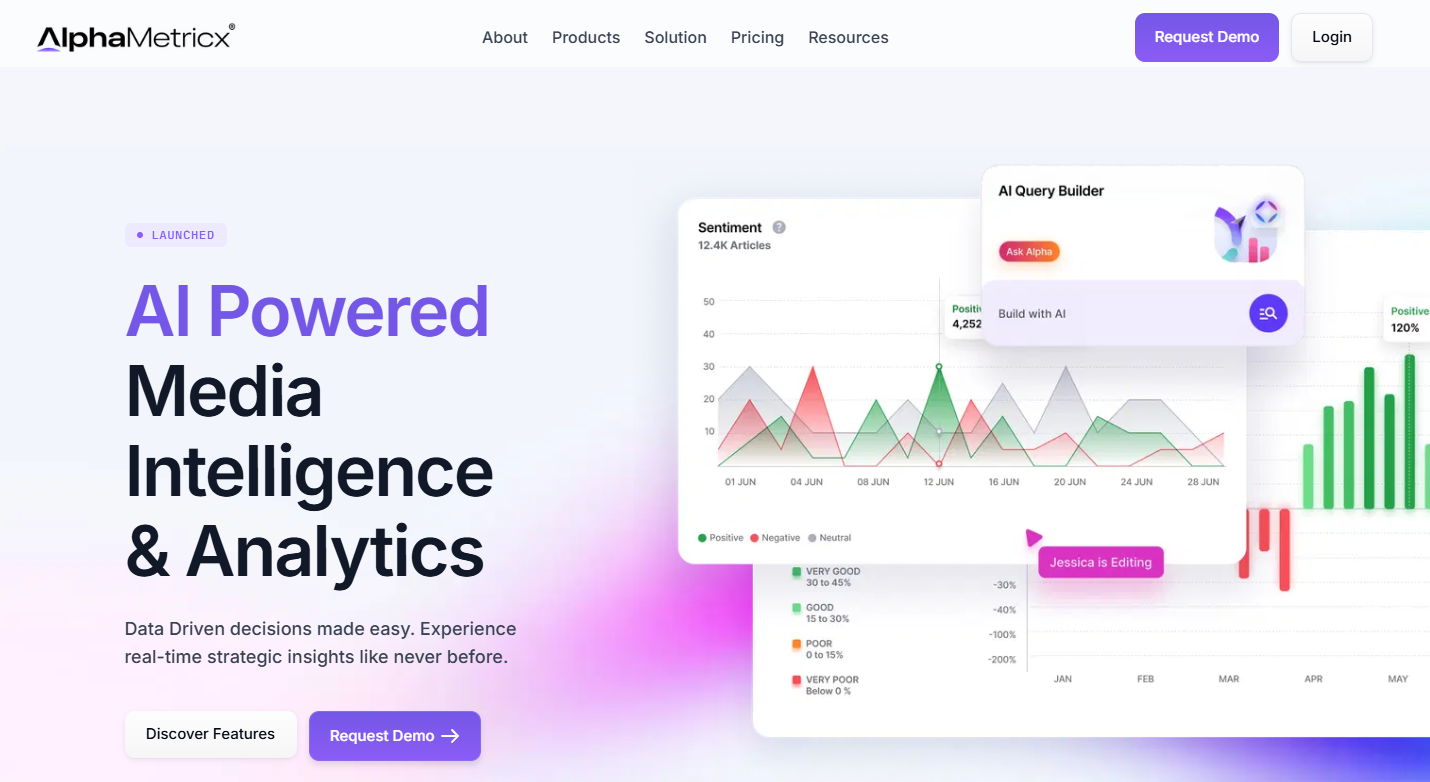
    AlphaMetricx is an AI-powered media intelligence platform that goes beyond surface data and provides actionable insights into brand reputation, competitor behavior, and market narrative. The platform stands out with its comprehensive monitoring and aims to assist decision-makers, PR teams, and communications leaders in their need to cut through the noise of modern media.

    AlphaMetricx was started by media veterans in 2024. They later developed the platform together with InfoVision Inc. AlphaMetricx combines machine learning, natural language processing, and human insight. It brings together views of an enormous universe of sources, from the traditional establishment (online, print) to the digital/social universe (reviews, forums, blogs), to deliver actionable insights and an end-to-end view of a brand’s media footprint.

    One of its strengths is its attempt to explain the “why” behind the numbers. Unlike mere real time monitoring of mention volume, AlphaMetricx has such advanced metrics like the “PR Impact Score” and “Message Congruence Analysis” that help the users measure the actual value and effect of brand coverage. It has been adopted by notable news publications such as PR Newswire, Tech Bullion, Associated Press and more.

    Our rating: 4.5 stars ★★★★☆

    Key Features

    • AI-Powered Search & Chatbot AI: Allows users to build complex search queries in natural language.
    • PR Impact Score: A proprietary measurement that calculates the true value of PR efforts by considering source prominence, audience reach, and performs advanced sentiment analysis, rather than simple mention counts.
    • Insights Layer: A differenciating feature that automatically finds out the reason behind sudden spikes in mentions, sentiment shifts, or new trends, providing critical insights.
    • Limitless Customizable Dashboards: Users are able to create customized dashboards for particular needs (e.g., brand, competitive analysis, campaigns) using both simple KPIs and complex PR metrics, offering extensive flexibility.
    • Automated Newsletters in Real-Time: After the users mention the topics, recipients, and timelines, the platform itself runs, extracts relevant data, and delivers detailed newsletters automatically, keeping entire teams up to date with the latest results.
    • Competitor Benchmarking: Keeps a tab on leading competitors by metrics like Share of Voice (SOV), Sentiment Spread, and Media Footprint to track coverage, brand perception, and identify industry trends, market gaps, and opportunities.

    Pros

    • Actionable Insights: Goes past “what happened” to explain “why it happened,” thanks to its advanced reporting through Insights Layer and PR Impact Score.
    • High Degree of Customization: Offers unlimited, completely customized dashboards and newsletters, allowing different teams to focus on what is most important to them.
    • Strong AI Integration: Search and conversational AI functions powered by AI drastically reduce the time and expertise needed to find deep insights and develop strategic plans.
    • Wide Data Sourcing: Pulls sound data from a wide variety of sources, both online and offline media, providing a balanced view of brand performance.

    Cons

    • Potential Learning Curve: The extent of features, including Boolean query tuning and advanced dashboard setup, can be a learning period for non-analyst users.
    • Custom Pricing Model: Lack of open, flat pricing can be a difficulty for small or mid-size teams.
    • Limited Third-Party Integration: No clear mention of native integrations with great CRM, BI, or marketing automation systems is available that might make some of the workflows easier for others.
    • Requires Dependence on Support: Individuals without strong technical resources may need to depend on the specialized team of analysts for the initial account setups, Boolean tweaking, setup and complex configurations.

    Coverage and Reach
    4.5

    Accuracy and Relevance
    4.5

    Real-Time Monitoring
    5

    Data Analysis and Reporting
    5

    Engagement Metrics
    4.5

    Competitive Intelligence
    5

    User Experience and Interface
    4

    Integration with Other Tools
    3.5

    Cost-Effectiveness
    4

    Security and Data Privacy
    4.5

    Customer Reviews and Reputation
    4.5

    Customer Support and Service
    5

    0
    0.5
    1
    1.5
    2
    2.5
    3
    3.5
    4
    4.5
    5

    2

    Brandwatch

    ★ 4.4

    Brandwatch

    Brandwatch is another PR tool dedicated to maintaining brand image and prying out customer insights. The software is used by organizations such as GSK, Toyota and Unilever.

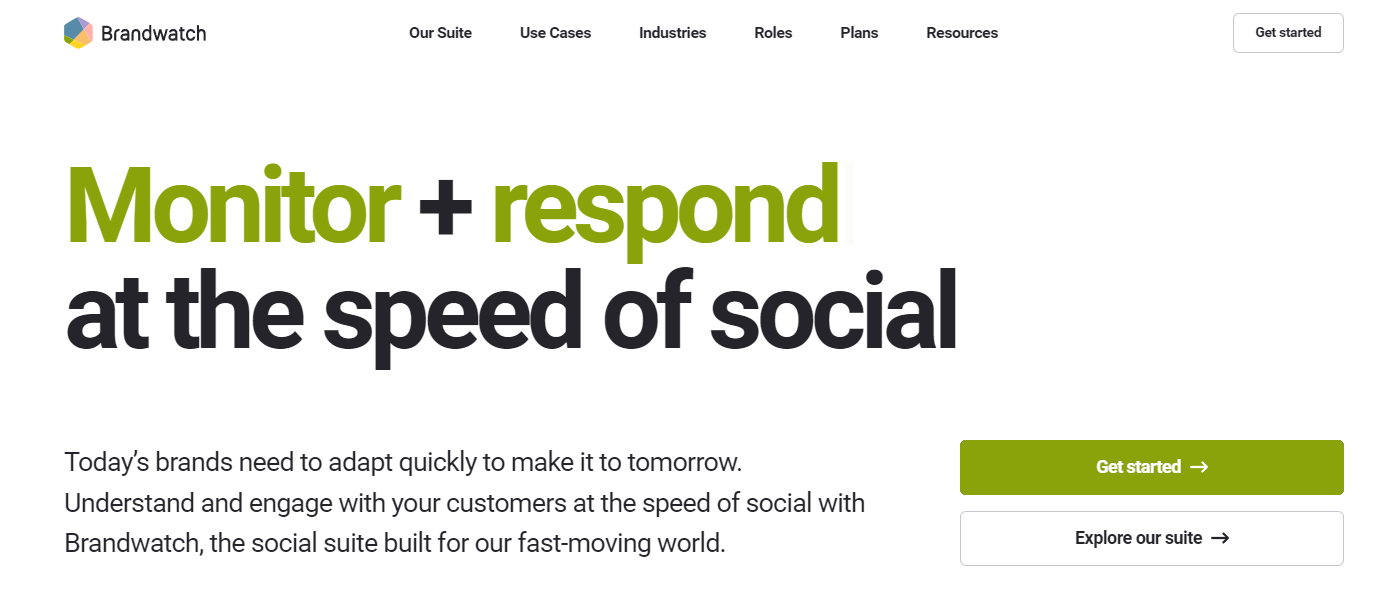
    Brandwatch includes a search feature that publishers can use to plug in and search through millions of online discussions. Relevant search topics appear alongside the keyword when searched, further breaking down how the keyword is being used.

    Iris, the Brandwatch AI, then automatically segments the brand discussions across several categories, allowing publishers to instantly visualize the different ways their product or content is being discussed.

    The Iris AI is also capable of measuring trends and the usage of keywords over time. One more interesting feature is the AI’s image analysis which can detect logos and objects within an image.

    Brandwatch doesn’t offer set prices, preferring those interested in its services to book a meeting to discuss their needs. The software could also benefit from updating its software to include platforms such as TikTok.

    Our rating: 4.4 stars ★★★★☆

    Key Features

    • Keyword search bar function
    • Measure historical keyword usage and trends
    • Automatic segmentation into topic categories
    • Image analysis capabilities are useful for publishers and marketers to see how their brand is being used in alternative formats
    • Could use more integrations into emerging social media such as TikTok.

    Pros

    • Excels in gathering data from a vast array of sources, including social media platforms, forums, and blogs.
    • Provides detailed insights into the emotional tone of consumer discussions, moving beyond simple positive or negative classifications.
    • Users can tailor dashboards to their specific needs, ensuring that key metrics and performance indicators are easily accessible for more effective decision-making.

    Cons

    • Some users have reported that the demographic information provided is somewhat limited.
    • There are instances where the sentiment analysis may misinterpret the context, leading to inaccuracies in assessing the sentiment of certain content.
    • Users have experienced occasional bugs within the platform, which can affect usability and require attention from the support team.

    Coverage and Reach
    4.5

    Accuracy and Relevance
    4.6

    Real-Time Monitoring
    4.5

    Data Analysis and Reporting
    4.7

    Engagement Metrics
    4.4

    Competitive Intelligence
    4.3

    User Experience and Interface
    4.4

    Integration with Other Tools
    4.5

    Cost-Effectiveness
    3.8

    Security and Data Privacy
    4.6

    Customer Reviews and Reputation
    4.3

    Customer Support and Service
    4.2

    0
    0.5
    1
    1.5
    2
    2.5
    3
    3.5
    4
    4.5
    5

    3

    Brand24

    ★ 4.3

    Brand24

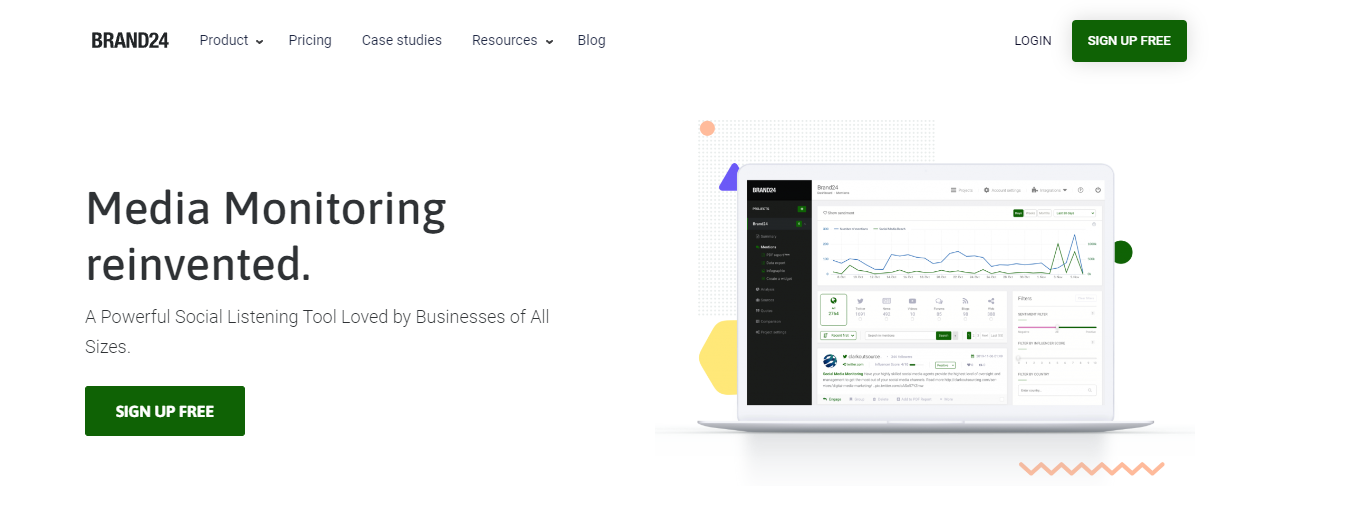
    Brand24 is a media monitoring software focused on mining customer insights from online social discussions and maintaining a healthy brand presence. The software is used by organizations such as Samsung, Intel and Stanford University.

    Brand24 employs an AI algorithm that crawls through social media platforms to find mentions of a keyword. That same AI then measures the sentiment of the mention to determine whether it is positive, negative or neutral.

    The platform then generates a word cloud of the mentions so that publishers can quickly and easily determine how their brands are being talked about. The software can also track mentions through hashtags.

    Brand 24 has four price points, with the difference being the number of keywords and mentions monitored. Some key features, such as PDF reports, are only available for the Pro version for $199 per month.

    Our rating: 4.3 stars ★★★★☆

    Key Features

    • $79 per month for three keywords and 2,000 mentions
    • $149 for seven keywords and 7,000 mentions
    • $199 for 12 keywords and 25,000 mentions
    • $399 for 25 keywords and 100,000 mentions
    • AI algorithm finds mentions in online spaces
    • Measure sentiment in customer mentions
    • Automatic word cloud generation useful for building associations around keywords
    • Hashtag monitoring is another useful trend-finder
    • Some essential features, such as generating PDF reports, are locked behind high tiers

    Pros

    • Tracks mentions across a wide array of online sources.
    • Users receive immediate notifications of new mentions, allowing for prompt responses to both positive and negative feedback.
    • It has a user-friendly interface that makes it accessible to users with varying technical expertise.

    Cons

    • The platform may not provide extensive historical data, potentially limiting long-term trend analysis.
    • Some users find its pricing to be on the high side for smaller businesses or startups, especially since access to advanced features often requires subscribing to more expensive plans.

    Coverage and Reach
    4.2

    Accuracy and Relevance
    4.5

    Real-Time Monitoring
    4.6

    Data Analysis and Reporting
    4.3

    Engagement Metrics
    4

    Competitive Intelligence
    4

    User Experience and Interface
    4.4

    Integration with Other Tools
    4.2

    Cost-Effectiveness
    4

    Security and Data Privacy
    4.7

    Customer Reviews and Reputation
    4.4

    Customer Support and Service
    4.3

    0
    0.5
    1
    1.5
    2
    2.5
    3
    3.5
    4
    4.5
    5

    4

    Meltwater

    ★ 4.3

    Meltwater

    Meltwater has been providing online media monitoring services since 2001. It can be applied in a variety of different sectors including news and social media, and their partnerships reflect this variety, with News Corp, Qantas and Afterpay all using the software.

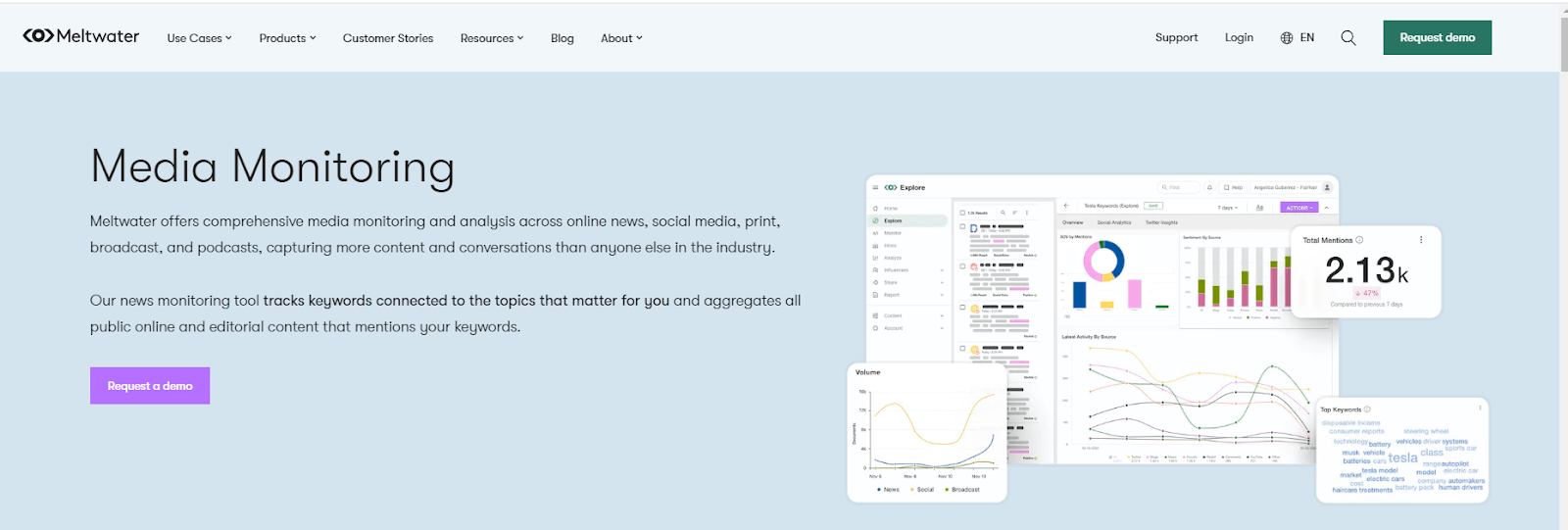
    Meltwater measures publishers against their competitors and then compares customer sentiment. Publishers can use this tool to determine where conversations about their brands are taking place, which can help determine which spaces to invest in. Meltwater offers comprehensive media analysis to help PR and Communications professionals prove the ROI of their earned media efforts.

    Meltwater can also determine emerging trends using a keyword search, with the results providing metrics such as the total number of searches, daily searches, related search terms and user sentiment.

    Meltwater doesn’t have set pricing, offering bespoke price packages based on publishers’ needs. There’s also no free trial, but it does provide an active demonstration.

    Our rating: 4.3 stars ★★★★☆

    Key Features

    • Determine user sentiment and who is talking about the brand
    • Keyword search to determine emerging trends
    • Broad nature of the program means it is great for both news and PR
    • Great analytics for customers and competitors
    • No free trial

    Pros

    • Has an intuitive interface, which simplifies navigation and utilization of its features.
    • Tracks media mentions across various channels, providing valuable insights into brand presence and public perception.
    • A responsive customer support team noted for assisting users in maximizing the platform’s potential.

    Cons

    • Occasional technical glitches that can disrupt workflow and require attention from support.
    • New users may experience a learning curve when using the platform for the first time.

    Coverage and Reach
    4.4

    Accuracy and Relevance
    4.5

    Real-Time Monitoring
    4.6

    Data Analysis and Reporting
    4.4

    Engagement Metrics
    4

    Competitive Intelligence
    4.1

    User Experience and Interface
    4.3

    Integration with Other Tools
    4.2

    Cost-Effectiveness
    3.8

    Security and Data Privacy
    4.5

    Customer Reviews and Reputation
    4.2

    Customer Support and Service
    4.1

    0
    0.5
    1
    1.5
    2
    2.5
    3
    3.5
    4
    4.5
    5

    5

    Agility PR Solutions

    ★ 4.2

    Agility PR Solutions

    Agility PR Solutions is a flexible media monitoring tool that can be employed to monitor a variety of different media types. Some prominent organizations that use this software include the University of Glasgow, Pandora and McDonald’s.

    A major draw to using Agility PR Solutions is the number of different types of media that the software can monitor. The software can track keywords across online media, print, blogs, press releases, broadcasts and internet forums. The keywords can also be compared side by side to judge the coverage over a period of time.

    The software is proficient at generating a snapshot of a keyword and sharing performance across teams and shareholders. It can craft dynamic reports by inserting real-time data into chart templates. Agility PR Solutions can also alert publishers to any oncoming crises by sending notifications if there are any unexpected trends in a keyword’s performance.

    While the company offers four annual planes — Media Database & Outreach, Media Monitoring, Enterprise Services and Social Listening — the company does provide set pricing. Interested parties need to contact the company itself.

    Our rating: 4.2 stars ★★★★☆

    Key Features

    • Alert publishers to a potential crisis.
    • Generate dynamic reports through templates
    • Compare keyword’s historical trends
    • Can monitor many different forms of media
    • Somewhat lacking in news gathering tools compared to other software

    Pros

    • Monitors a wide array of media types, including online, print, blogs, press releases, broadcasts, and internet forums.
    • Enables the creation of dynamic reports by integrating real-time data into customizable chart templates.
    • Notifies users of unexpected trends in keyword performance.

    Cons

    • Lacking in news gathering tools, which could impact the comprehensiveness of media monitoring efforts.
    • Absence of publicly available pricing information necessitates direct contact with the company for details, potentially hindering immediate budget assessments.
    • New users might require time to fully utilize the platform’s comprehensive features and services, indicating a potential learning curve

    Coverage and Reach
    4.3

    Accuracy and Relevance
    4.5

    Real-Time Monitoring
    4.4

    Data Analysis and Reporting
    4.3

    Engagement Metrics
    4.1

    Competitive Intelligence
    3.9

    User Experience and Interface
    4.4

    Integration with Other Tools
    4

    Cost-Effectiveness
    3.8

    Security and Data Privacy
    4.6

    Customer Reviews and Reputation
    4.3

    Customer Support and Service
    4.1

    0
    0.5
    1
    1.5
    2
    2.5
    3
    3.5
    4
    4.5
    5

    6

    CISION

    ★ 4.2

    CISION

    CISION is a diverse media monitoring software that’s useful to the publishing industry thanks to the wide range of media it monitors. Some organizations that use CISION include LinkedIn, 3M and PBS.

    CISION uses an intuitive search feature to find keywords across sources and to find connected journalists to pitch to. The software also builds interactive reports to detect trends and also stacks publishers’ performance against their competitors.

    Unlike others on this list, CISION can track keywords across paywalled content as well as digital print media. The software can also find mentions in broadcast media. It also employs a speech-to-text AI to find mentions in podcasts and other forms of audio-based media.

    However, the software does have its limitations, particularly in its media and journalist database. CISION does not cover every media outlet and not every journalist is available to find. The softwares analytics could also be more in-depth.

    Our rating: 4.2 stars ★★★★☆

    Key Features

    • Intuitive keyword search
    • Monitor paywalled content
    • Compare performance against competitors with interactive reports
    • Can monitor alternative formats such as broadcast and podcast content
    • Limitations in media coverage and analytics

    Pros

    • Offers extensive media monitoring capabilities, allowing users to track coverage across various channels.
    • Excels in press release creation, providing effective tools for crafting and distributing press releases to targeted audiences.
    • Provides metrics to measure the true value of earned media.

    Cons

    • Some users have reported a lack of transparency in billing practices, with additional charges for certain options not being clearly communicated upfront.
    • Modifies URLs without user consent, leading to missed backlinking opportunities.
    • Due to its comprehensive feature set, new users may experience a learning curve when navigating and fully utilizing the platform.

    Coverage and Reach
    4.5

    Accuracy and Relevance
    4.4

    Real-Time Monitoring
    4.3

    Data Analysis and Reporting
    4.5

    Engagement Metrics
    4.2

    Competitive Intelligence
    4

    User Experience and Interface
    4.2

    Integration with Other Tools
    4.3

    Cost-Effectiveness
    3.7

    Security and Data Privacy
    4.5

    Customer Reviews and Reputation
    4.1

    Customer Support and Service
    4.1

    0
    0.5
    1
    1.5
    2
    2.5
    3
    3.5
    4
    4.5
    5

    7

    Dataminr

    ★ 4.2

    Dataminr

    Dataminr is a real-time media monitoring tool that is well-suited for the public and news sectors thanks to the event-finding capabilities of its machine-learning AI. Publishers such as Aljazeera, Deutsche Welle and the Daily Mail use the software.

    To ensure that Dataminr stays ahead of the competition, the software analyzes more than 500,000 public sources and reports back to publishers information about their chosen keyword or location. The sources can include text, images, sound and videos.

    An interesting feature that journalists and publishers can take advantage of is Dataminr’s geo-visualiser. As events unfold, publishers can use the geo-visualiser to see events happening nearby for a bird’s-eye approach to breaking events. Events continuously update as situations change and evolve.

    The software comes with a suite of visual collaborative tools to ensure that entire news teams can adapt and work on breaking stories in a cohesive and efficient manner. However, high-event locations — such as disaster zones — can generate a lot of noise and make information harder to dissect. UI changes that filter results or minimize the sizes of events could be useful to make data more accessible.

    Dataminr doesn’t display its prices or plans, preferring publishers contact it directly to arrange a demo.

    Our rating: 4.2 stars ★★★★☆

    Key Features

    • Analyze more than 500,000 public sources
    • Collaborative tools for news team workflows
    • Continuously updates in real-time
    • Geo-visualiser is a innovative way to see the effects of events at a broader local scale
    • High-event locations generate lots of noise

    Pros

    • Interface is intuitive, facilitating efficient navigation and utilization.
    • Enhances operational efficiency by providing timely alerts.
    • Aids in effective incident management by offering crucial real-time information.

    Cons

    • Challenges during the initial setup process, indicating a need for improved onboarding procedures.
    • Offers limited customization options, potentially restricting users from tailoring the system to their specific needs.
    • New users might require time to become proficient with its features.

    Coverage and Reach
    4.6

    Accuracy and Relevance
    4.7

    Real-Time Monitoring
    4.8

    Data Analysis and Reporting
    4.3

    Engagement Metrics
    3.8

    Competitive Intelligence
    3.5

    User Experience and Interface
    4.2

    Integration with Other Tools
    4

    Cost-Effectiveness
    3.5

    Security and Data Privacy
    4.7

    Customer Reviews and Reputation
    4.4

    Customer Support and Service
    4.3

    0
    0.5
    1
    1.5
    2
    2.5
    3
    3.5
    4
    4.5
    5

    9

    KeyTrends

    ★ 4.2

    KeyTrends

    KeyTrends is a media monitoring tool with features that can assist publishers with creating content by automatically generating content briefs and alerting them to trending stories. The software is used by the likes of Cinfa, UCI and Erudit.

    One of the platform’s key features is its ability to automatically generate content with an AI assistant based on GPT3.5 (ChatGPT).

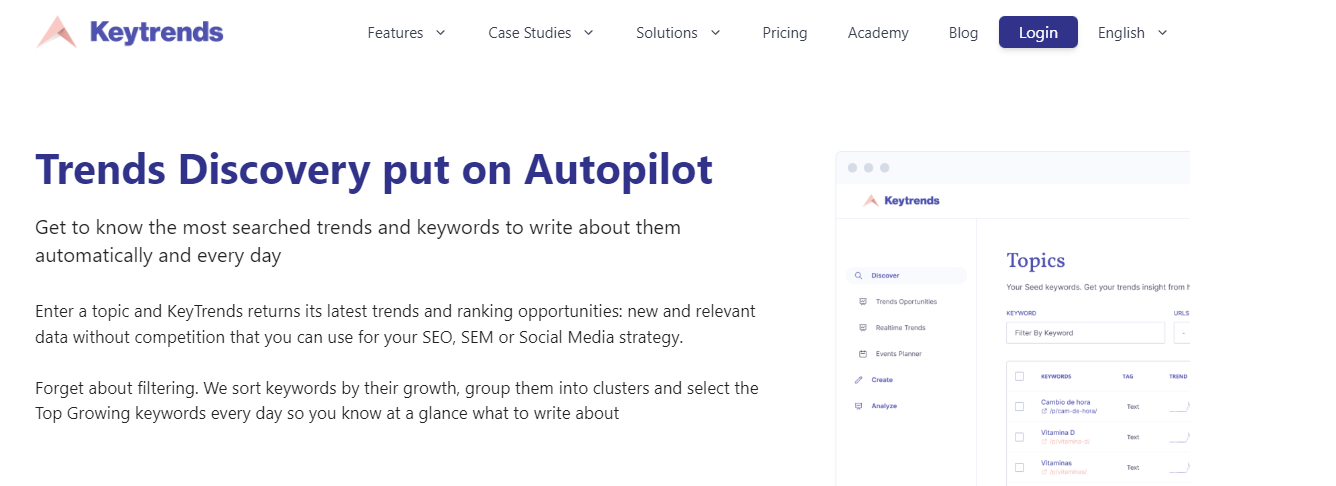
    KeyTrends’ “Trends Discovery” feature, meanwhile, searches keywords by growth rather than general keyword tracking. This allows publishers to uncover emerging trends in topics and reduces the amount of filtering required to find valuable items. Unfortunately, KeyTrends doesn’t provide a snapshot of how the keyword is being used within media items, instead providing general metrics for usage.

    There are three different price tiers for KeyTrends:

    • Standard: €59 (~$65) per month for 50 trends
    • Advanced: €199 (~$215) per month for 150 trends
    • Premium: €299 (~$325) per month for 500 trends

    There is also a custom option for publishers who want to tailor the features they have access to.

    Our rating: 4.2 stars ★★★★☆

    Key Features

    • Automatically generate content with AI
    • Search for trends across topics by growth
    • Useful for uncovering trends and keyword performance
    • Transparent pricing with flexible options
    • Not as useful for monitoring specific media stories from other publications

    Pros

    • Utilizes AI to generate comprehensive content briefings in under five minutes.
    • Identifies emerging trends and uncovers uncompetitive positioning opportunities.
    • Conducts in-depth analyses to detect relevant keywords, entities, and queries.

    Cons

    • Some users may find the platform’s comprehensive features challenging to navigate initially.
    • The cost may be a consideration for smaller businesses or startups with limited budgets.

    Coverage and Reach
    4.3

    Accuracy and Relevance
    4.4

    Real-Time Monitoring
    4.5

    Data Analysis and Reporting
    4.4

    Engagement Metrics
    3.8

    Competitive Intelligence
    3.9

    User Experience and Interface
    4.2

    Integration with Other Tools
    4.1

    Cost-Effectiveness
    3.7

    Security and Data Privacy
    4.6

    Customer Reviews and Reputation
    4.3

    Customer Support and Service
    4.1

    0
    0.5
    1
    1.5
    2
    2.5
    3
    3.5
    4
    4.5
    5

    10

    Muck Rack

    ★ 4.2

    Muck Rack

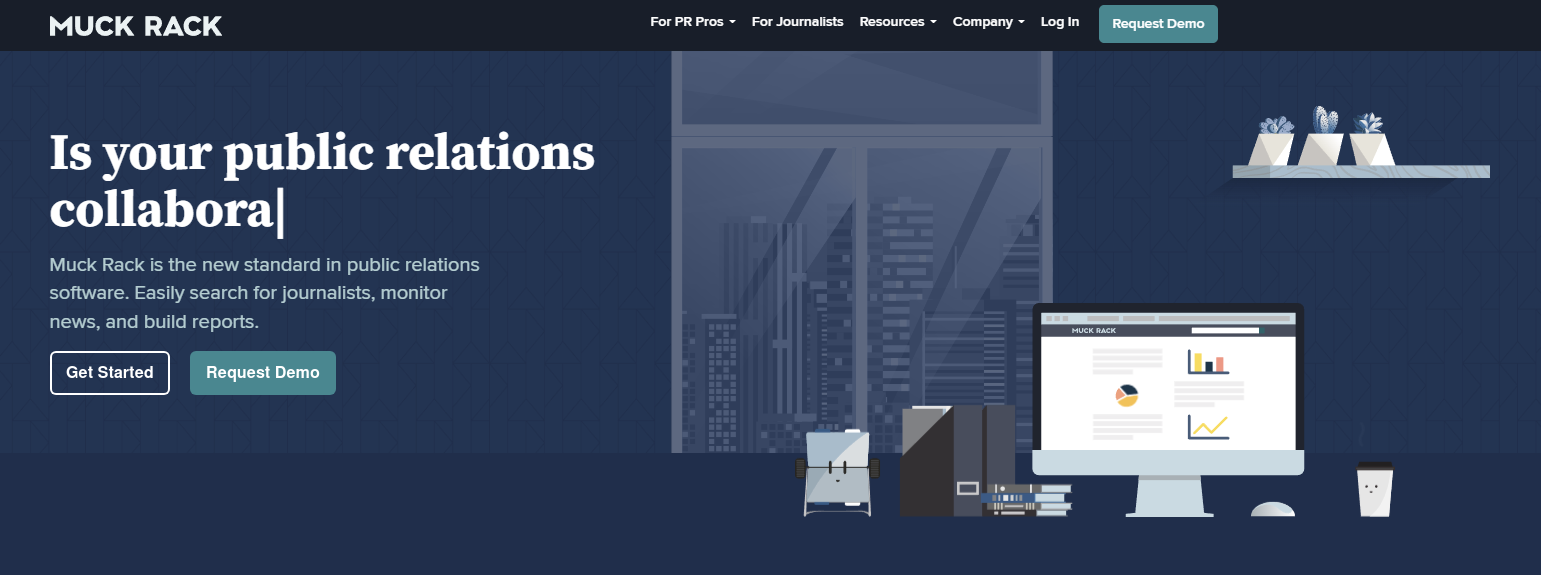
    Muck Rack is another PR tool packaged with a media monitoring tool, which is useful for maintaining brand image and for monitoring the press landscape. The software is used by organizations such as A&E, Comcast and Pfizer.

    Publishers using Muck Rack to monitor media can assign a keyword to receive alerts whenever that topic is mentioned. The software then generates a coverage report with analytics about that chosen keyword. Muck Rack provides curated media monitoring reports to help businesses separate the noise from important news and communicate with key stakeholders.

    Muck Rack also includes a media database to build connections with other members of the media. Their database allows for publishers to pitch stories to journalists and track their progress on projects. In that sense, it has some unique functions for project management.

    Our rating: 4.2 stars ★★★★☆

    Key Features

    • Receive alerts around chosen keyword
    • Generates a coverage report with analytics
    • Connecting with journalists through Muck Rack’s media database
    • Progress tracking software is useful for brand publishers
    • Not a strong focus on news gathering

    Pros

    • Intuitive interface, which simplifies navigation and enhances user experience.
    • Provides access to a vast and up-to-date database of journalists and media outlets, facilitating targeted outreach.
    • Offers a suite of tools, including media monitoring, social listening, and customizable reporting, enabling PR professionals to manage campaigns effectively.

    Cons

    • Occasional inaccuracies in the media database, which can affect the precision of outreach efforts.
    • Limited coverage in specific areas may require users to supplement their media monitoring with additional tools.

    Coverage and Reach
    4.3

    Accuracy and Relevance
    4.5

    Real-Time Monitoring
    4.2

    Data Analysis and Reporting
    4

    Engagement Metrics
    4

    Competitive Intelligence
    3.8

    User Experience and Interface
    4.4

    Integration with Other Tools
    4

    Cost-Effectiveness
    3.7

    Security and Data Privacy
    4.5

    Customer Reviews and Reputation
    4.2

    Customer Support and Service
    4.5

    0
    0.5
    1
    1.5
    2
    2.5
    3
    3.5
    4
    4.5
    5

    11

    Isentia

    ★ 4.1

    Isentia

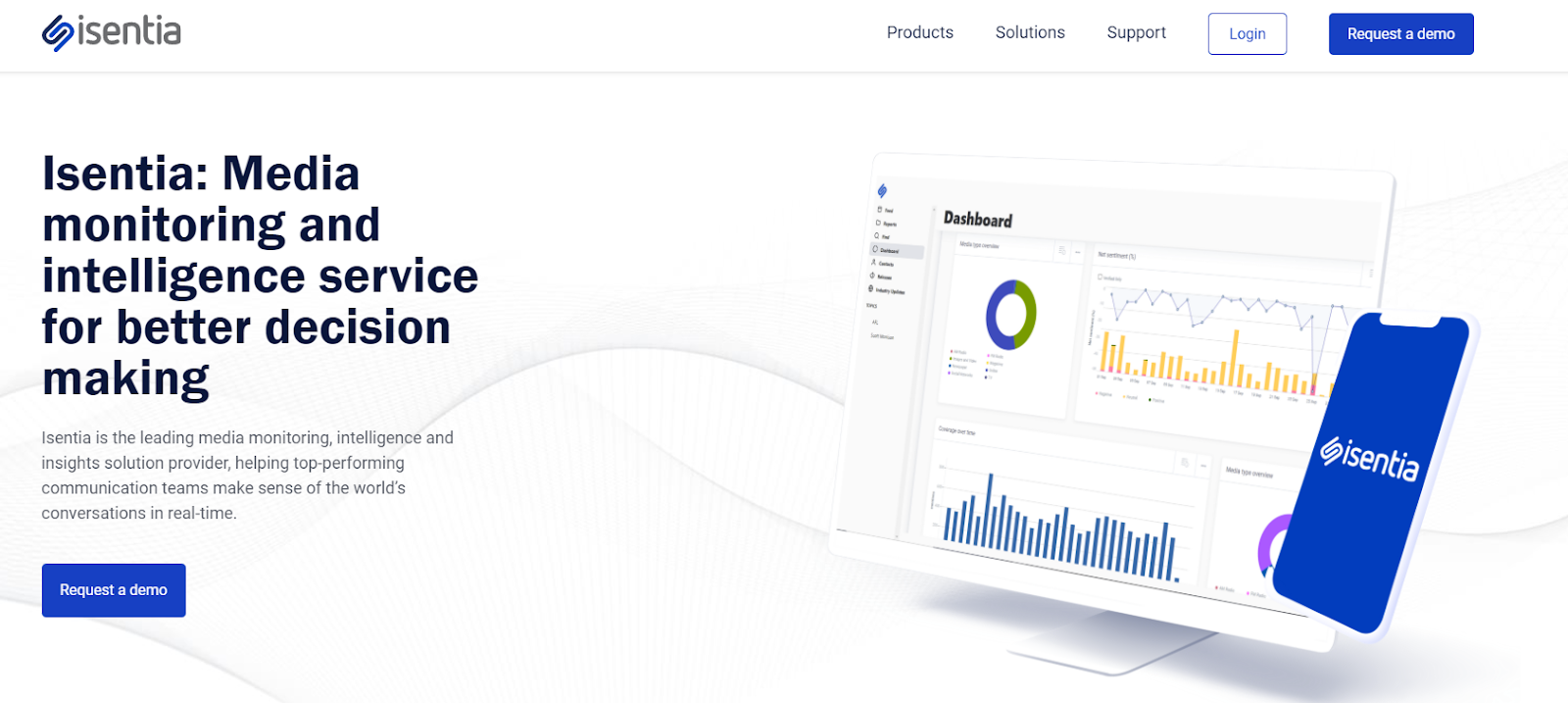
    Rather than focus on key terms, media monitoring company Isentia instead provides a birds-eye view of media coverage. This software is particularly good for the news and social media sector, with the New Zealand government, Sunway and Tenaga Nasional adopting the software.
    Isentia distills all recent media coverage into a centralized feed. Publishers are fed a snapshot of emerging topics, and quickly gauge public and media reactions. The coverage can be sorted into topics and can be broken down into locations.

    As a step further, Isentia also provides additional media monitoring solutions with its edited daily brief that media monitoring experts tailor to summarize the coverage of a publisher’s topic of choice.

    Isentia doesn’t have a set standard price, with publishers paying based on the number of features they want.

    Our rating: 4.1 stars ★★★★☆

    Key Features

    • Coverage of media presented in a feed
    • Daily edited briefs
    • Particularly good software for the news sector
    • Pricing scheme has room for customization
    • Less immediate service for essential PR risk mitigation

    Pros

    • Offers extensive coverage across print, broadcast, online, and social media platforms, enabling organizations to stay informed about relevant news and trends.
    • Provides branded and customizable reports, allowing users to tailor insights to their needs.
    • Connect feature grants access to a constantly updated database of journalists.

    Cons

    • Interface is less intuitive compared to competitors, potentially leading to a steeper learning curve.
    • Content calendar features are considered less robust, which may hinder effective coordination of content strategies.
    • Customer support may not meet user expectations, affecting the overall user experience.KeyTrends

    Coverage and Reach
    4.3

    Accuracy and Relevance
    4.4

    Real-Time Monitoring
    4.2

    Data Analysis and Reporting
    4

    Engagement Metrics
    4

    Competitive Intelligence
    3.8

    User Experience and Interface
    4.1

    Integration with Other Tools
    4

    Cost-Effectiveness
    3.7

    Security and Data Privacy
    4.5

    Customer Reviews and Reputation
    4.2

    Customer Support and Service
    4

    0
    0.5
    1
    1.5
    2
    2.5
    3
    3.5
    4
    4.5
    5

    13

    Determ

    ★ 4.2

    Determ

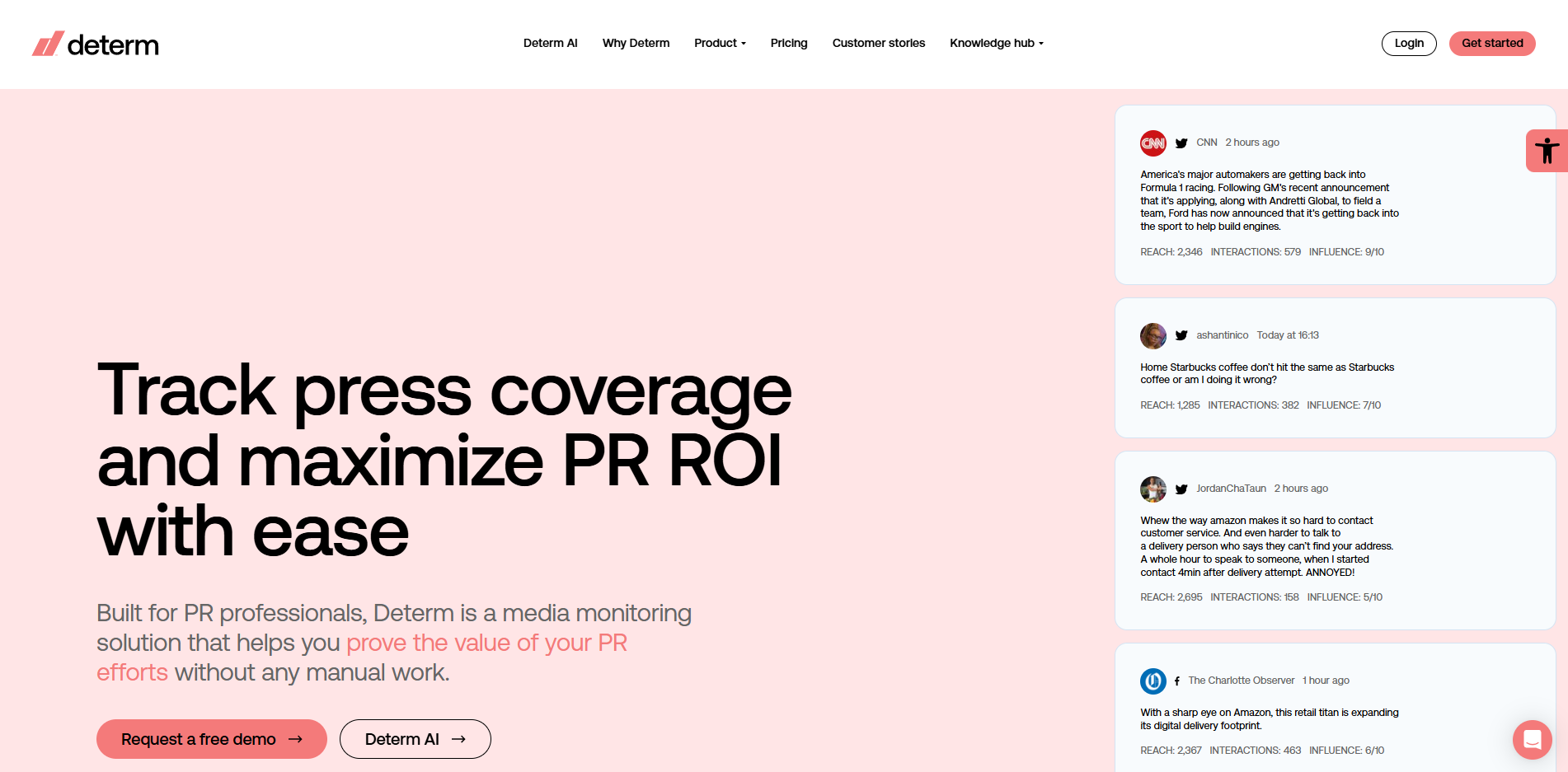
    Determ is an AI-powered media monitoring tool that enables publishers to track brand mentions, trending topics, and audience sentiment across digital platforms. Renowned organizations like Forbes, The Guardian, and Reuters utilize Determ for real-time insights from over 100 million online sources, including news sites, blogs, and social media.

    By scanning these sources every few minutes, Determ promptly alerts publishers to breaking news and emerging content opportunities. The platform also offers competitive analysis, allowing users to benchmark their visibility against industry rivals. To explore its comprehensive features, Determ provides a free trial for publishers.

    Our rating: 4.1 stars ★★★★☆

    Key Features

    • Real-time media tracking for publishers.
    • Competitor analysis & content performance insights
    • Custom alerts for breaking news & trends
    • AI assistant Synthia and comprehensive analytic

    Pros

    • Covers a vast range of digital media sources with multilingual support.
    • AI-driven sentiment analysis and smart filtering.
    • Real-time alerts and customizable notifications.
    • Intuitive analytics dashboard with historical data access and custom reports.
    • Competitor and influencer tracking.

    Cons

    • Limited coverage of traditional media like TV and radio reduces its reach.
    • Lack of upfront pricing transparency makes cost assessment difficult for smaller publishers.
    • Social media engagement tracking could be expanded to include real-time interactions and virality scores.
    • Better integration with CMS and SEO tools would streamline workflow for content teams.
    • More guided tutorials and AI-driven insights would enhance usability for new users.

    Coverage and Reach
    4.2

    Accuracy and Relevance
    4.5

    Real-Time Monitoring
    4

    Data Analysis and Reporting
    4.3

    Engagement Metrics
    4.1

    Competitive Intelligence
    3.8

    User Experience and Interface
    4.4

    Integration with Other Tools
    4

    Cost-Effectiveness
    3.7

    Security and Data Privacy
    4.6

    Customer Reviews and Reputation
    4.2

    Customer Support and Service
    4

    0
    0.5
    1
    1.5
    2
    2.5
    3
    3.5
    4
    4.5
    5

    13

    Prowly

    ★ 4.1

    Prowly

    Prowly is a social media monitoring software focused on PR and customer relationships, but can be useful for publishers of branded content. Organizations such as Universal Music Group, ASUS and LG use the platform.

    Prowly’s media monitoring AI is able to find keywords on social media and media coverage and detect sentiment within the writing. Publishers can tailor their notifications to highlight negative public sentiment in order to coordinate an effective response.

    Other functions available on the platform include the ability to design and create press releases and the ability to set up a dedicated newsroom. Prowly also connects users to its media database and to its many journalists.

    Prowly includes two different price points: its essential bundle for $418 per month which includes the ability to send, schedule and analyze 3,000 emails for two users, and its professional bundle for $568 per month with 15,000 emails and five users. If publishers opt to pay on an annual basis, then they can save up to 30%.

    The company also offers a seven-day free trial.

    Our rating: 4.1 stars ★★★★☆

    Key Features

    • Find keywords on social media and online news
    • Design and create press releases
    • Connects brand publishers to pitch to journalists
    • Efficient generation press releases
    • Seven-day free demo
    • Not as much focus on news and story creation compared to other tools

    Pros

    • Provides access to a database of a large number of media contacts, facilitating targeted outreach to relevant journalists and influencers.
    • Has an intuitive design, making it easy to navigate and utilize its features effectively.
    • Offers a suite of tools enabling users to manage all aspects of their PR campaigns in one place.

    Cons

    • Occasional challenges with the platform’s email management features, such as difficulties in tracking email performance and managing contacts.
    • Need for more advanced functionalities, indicating that the platform may not fully meet the needs of larger organizations with complex PR requirements.

    Coverage and Reach
    4.2

    Accuracy and Relevance
    4.3

    Real-Time Monitoring
    4

    Data Analysis and Reporting
    4.1

    Engagement Metrics
    3.9

    Competitive Intelligence
    3.5

    User Experience and Interface
    4.5

    Integration with Other Tools
    4

    Cost-Effectiveness
    4

    Security and Data Privacy
    4.5

    Customer Reviews and Reputation
    4.3

    Customer Support and Service
    4.2

    0
    0.5
    1
    1.5
    2
    2.5
    3
    3.5
    4
    4.5
    5

    14

    News Exposure

    ★ 4.1

    News Exposure

    News Exposure is a comprehensive media monitoring service that assists businesses in tracking their media presence across various platforms, including print, internet, social media, TV, and radio. Established in 2010, the company has developed an extensive HD digital archive dating back to 1984, offering clients access to historical media content.

    Our rating: 4.1 stars ★★★★☆

    Key Features

    • Covers television broadcasts across all 210 Nielsen Media Research Designated Market Areas (DMAs) in the U.S., encompassing over 1,200 channels, including national networks, cable channels, and local markets.
    • Offers 24/7 monitoring of online media sources to keep clients informed about their digital footprint.
    • Provides metrics that allow clients to assess the impact of their media coverage, including data parameters such as source, city, state, tone, placement, and prominence.
    • Utilizes an extensive, continually updated media contacts database for effective press release distribution and media pitches.

    Pros

    • Monitors a wide range of media outlets.
    • Offers access to a high-definition digital archive dating back to 1984
    • Provides both DIY (Do-it-Yourself) and DFY (Done-for-You) options

    Cons

    • The lack of upfront pricing information makes it challenging for potential clients to assess cost-effectiveness.
    • Some advanced services may incur extra charges
    • New users might require time to fully utilize the platform’s comprehensive features and services.

    Coverage and Reach
    4

    Accuracy and Relevance
    4.2

    Real-Time Monitoring
    4.1

    Data Analysis and Reporting
    4

    Engagement Metrics
    4

    Competitive Intelligence
    3.8

    User Experience and Interface
    4.3

    Integration with Other Tools
    3.9

    Cost-Effectiveness
    3.7

    Security and Data Privacy
    4.5

    Customer Reviews and Reputation
    4.1

    Customer Support and Service
    4

    0
    0.5
    1
    1.5
    2
    2.5
    3
    3.5
    4
    4.5
    5

    How to Choose the Best Media Monitoring Tool

    There are many factors to weigh up when deciding which monitoring tool is the best fit for your organization. Here are a few to consider:

    What Formats It Monitors

    For some sectors of publishing, some functions of media monitoring tools are absolute musts. For example, a publisher working within the broadcast sector must ensure that their media monitoring tool monitors formats standard in the industry — audio and visual.

    Some social media monitoring tools also specialize only in those platforms but don’t monitor paywalled content, digital newspapers or other forms of media. For some publishers monitoring online social spaces, this may be okay, but others may need to monitor both traditional media and social platforms.

    Scale

    The more money a publisher is able to invest into a media monitoring tool increases the amount of monitoring they are able to accomplish. However, publishers should consider whether this is necessary before deciding.

    If a publication is on the smaller side, focusing on a single niche, then perhaps a single keyword alert will be enough for them. For enterprises, options for unlimited keywords will prove necessary.

    Its Feature set

    Media monitoring tools have features that cater to select needs. For monitoring tools related to public relations, features that alert quickly and generate efficiently automated reports are useful for quick action against crises. For media monitoring tools that focus on news, any features that contribute to sourcing stories, such as gathering snapshots of media and identifying related keywords, are a boon.

    Free Trials and Demonstrations

    The best way publishers can determine whether or not a media monitoring software will benefit their organization is to try it out for themselves. Luckily, many of the listed options have some sort of free trial or demonstration attached to them.

    However, publishers shouldn’t stop at just one, as it’s important to compare the features of several before deciding.

    Media monitoring tools are an essential part of a publisher’s editorial strategy. They play two key roles: generating inspiration and information sources for content and mitigating risk to brand image.
    However, their use isn’t limited to digital publishing, or even marketing more broadly. Organizations working within the public sector regularly find some use for media monitoring tools, whether it be gathering insight into the general public opinion over legislation or quickly and accurately identifying damage in case of a disaster or crisis.

    Publishers can use these tools to strategize and plan for their content. Content strategy is a broad segment, however, and there are other tools that could be more useful on this front.

    For tools that can help publishers organize their content, check out our article on the 13 Best Editorial Calendar Software.

    FAQs 

    What Is Media Monitoring and Analysis?

    Media monitoring and analysis is the process of tracking and analyzing trends in print, social, broadcast and other types of media. Media monitoring in digital software automates many of these processes and can alert its users to breakout stories, news trends and other emerging topics in media.

    How Can I Track Media Mentions?

    Media monitoring software with a keyword tracking feature can be used to track media mentions. This keyword could be a topic, brand or locale. Different software may have different steps to input a keyword, while others such as Google Alerts have its keyword input on the main page. The software then notifies the user of any mention.

    How Do I Monitor Media Coverage?

    Monitoring media coverage can either be done manually by sifting through various different news sites to build a report or doing it automatically using media monitoring software. Media monitoring software aggregates data from inputted keywords and generates a holistic report of the media coverage.