






This article is republished from The Conversation under a Creative Commons license. Read the original article.
In the wake of Elon Musk closing the deal to buy Twitter on October 27 and soon after firing the management, users have been reconsidering the platform.
Hashtags #TwitterMigration and #TwitterExodus are gaining popularity, and the most common name found in conjunction with it is Mastodon – the new home for fleeing tweeters.
In fact, Mastodon is not that new. It was launched in October 2016 by German software developer Eugen Rochko, spurred on by his dissatisfaction with Twitter and his concerns over the platform’s centralised control.
After its 15 minutes of fame in early 2017, Mastodon’s growth slowed to a crawl.
Now, it’s on the upswing again – more than 70,000 users joined the network the day after Musk’s Twitter deal was announced. At the time of writing, Mastodon has reached more than a million active users, with almost half a million new users since October 27.
Meanwhile, Twitter was losing its most active users from its 238-million-strong user base even before Musk acquired the platform.
 Screenshot of the Mastodon server selection page. Mastodon
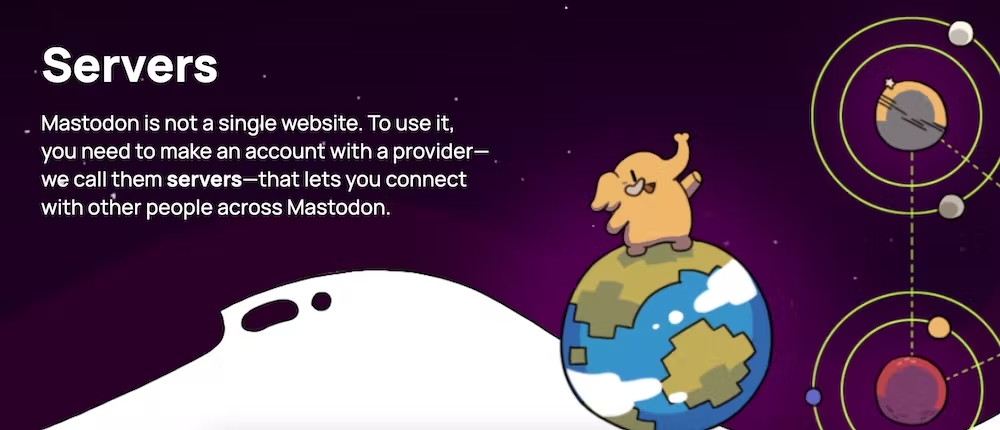
Servers are grouped by topic and location, and are supposed to bring users together by common interest. The server is also where your account lives, so your account name will be nickname@server-name (more on this later).
There are currently just over 4,000 servers to choose from. Some are closed for registration as they have reached capacity or simply prefer to keep their communities smaller. For example, Mastodon’s flagship server mastodon.social is not currently accepting new members.
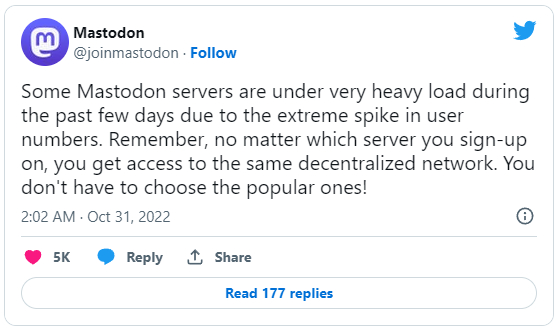
After you register by joining your chosen server, the interface looks somewhat similar to Twitter, with short posts (up to 500 characters by default) called “toots” instead of “tweets”. Given the recent spike in popularity, the app can be slow to respond, as some servers are experiencing heavy loads.
Screenshot of the Mastodon server selection page. Mastodon
Servers are grouped by topic and location, and are supposed to bring users together by common interest. The server is also where your account lives, so your account name will be nickname@server-name (more on this later).
There are currently just over 4,000 servers to choose from. Some are closed for registration as they have reached capacity or simply prefer to keep their communities smaller. For example, Mastodon’s flagship server mastodon.social is not currently accepting new members.
After you register by joining your chosen server, the interface looks somewhat similar to Twitter, with short posts (up to 500 characters by default) called “toots” instead of “tweets”. Given the recent spike in popularity, the app can be slow to respond, as some servers are experiencing heavy loads.
 For those looking for a relatively seamless transition without losing their online community, there is a Twitter migration toolkit for finding your followers and follows on Mastodon.
There is also a tool that allows you to cross-post between the two.
For those looking for a relatively seamless transition without losing their online community, there is a Twitter migration toolkit for finding your followers and follows on Mastodon.
There is also a tool that allows you to cross-post between the two.
How difficult is it to sign up to Mastodon?
Registering on the network takes a few minutes, just like any other social media app. However, Mastodon is not a Twitter clone – you need to choose a server to join.
Screenshot of the Mastodon server selection page. Mastodon
Servers are grouped by topic and location, and are supposed to bring users together by common interest. The server is also where your account lives, so your account name will be nickname@server-name (more on this later).
There are currently just over 4,000 servers to choose from. Some are closed for registration as they have reached capacity or simply prefer to keep their communities smaller. For example, Mastodon’s flagship server mastodon.social is not currently accepting new members.
After you register by joining your chosen server, the interface looks somewhat similar to Twitter, with short posts (up to 500 characters by default) called “toots” instead of “tweets”. Given the recent spike in popularity, the app can be slow to respond, as some servers are experiencing heavy loads.
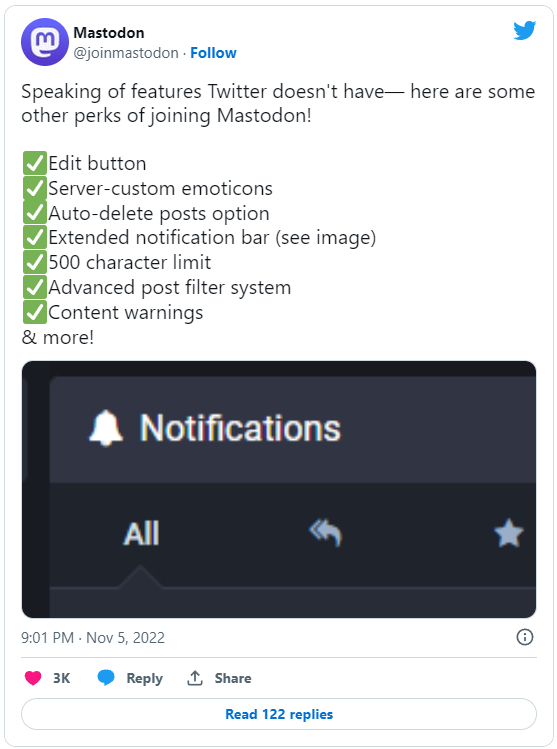
For those looking for a relatively seamless transition without losing their online community, there is a Twitter migration toolkit for finding your followers and follows on Mastodon.
There is also a tool that allows you to cross-post between the two.