




How important are formats to publishers? It’s about as broad and vague a question as anyone could ask, I know, but bear with me and it should make sense.
I’ve been thinking about the importance of formats on and off for about a decade, ever since my years-long effort to convince my management team that we needed to stop designing our publications in Microsoft Word and switch to Adobe InDesign paid off.
Given our lack of in-house design talent (as hinted at by our dogmatic use of Word), we contracted a designer to both develop the various publication templates and teach us how to use them.
The difference in how the products looked was night and day and gave the editors more freedom to introduce new graphics and images that wouldn’t have been possible before. With that said, I still remember how surprised our designer was at our desire to upgrade our format, noting that publishers in general seemed relatively disinterested in investing in redesigns.
This lined up with my own experience of how long it took management to embrace change. And that’s why it was so interesting to read Anna Sofia Lippolis’ analysis last year of The Verge’s root and stem design facelift.
The Verge’s Facelift
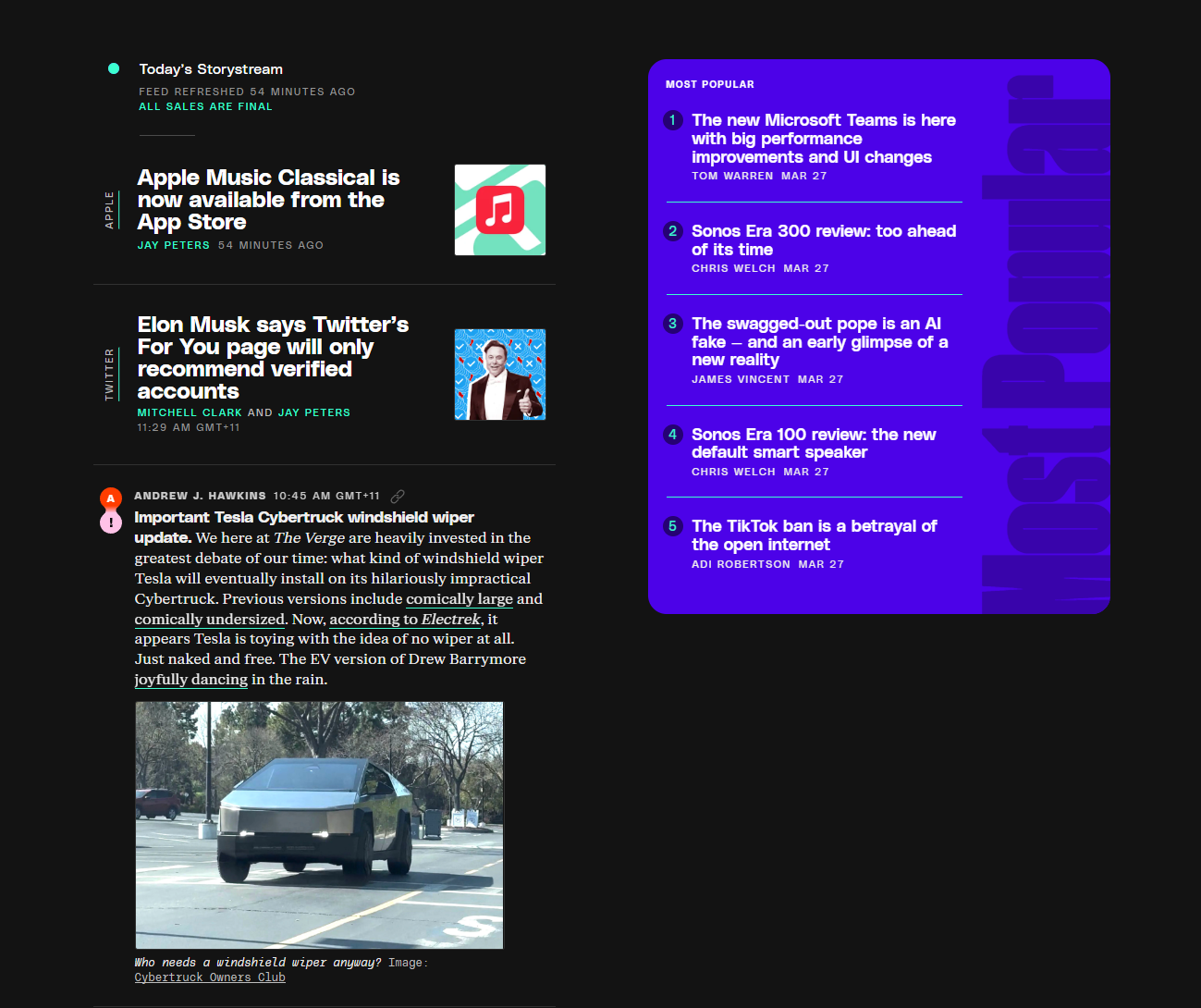
The Verge decided to overhaul its website not because it saw other media outlets as its competitors, but so that it could challenge “Twitter and other aggregators of audience”. A quick look at The Verge’s homepage and its intentions become immediately clear.
As users scroll down the page away from the main stories they encounter an automatically updated content feed on the left and modules on the right that focus on segments such as most popular stories, tech and podcasts.
A basic analysis of The Verge’s traffic over the December-February period shows that the site’s desktop traffic numbers have been growing steadily. Moreover, direct traffic was the second largest source of visits in February commanding a 40.25% share, while organic search delivered 47.25% of visits. Social media only delivered 5.89% of traffic.
But my opening question wasn’t limited to publication format. It meant formats across the board. And tackling the issue of story formats, the Rebooting’s Brian Morrissey made a compelling argument against digital frippery this week, noting that story formats were “important and yet invariably limited forms of differentiation”.
While I agree with his take on publications living or dying by valuing substance over style, I do think the argument becomes a touch reductionist.
Missing Nuance
Take Morrissey’s description of the Hot Ones YouTube channel as a typical interview show whose schtick is to have celebrities “eating wings while talking”. While not technically wrong, it lacks nuance.
The Verge examined the Hot Ones’ success back in 2019 — if you’re not familiar with the channel or why it’s successful then that article is as good a place as any to start.
Essentially, there’s more to the Hot Ones than celebrities eating wings. The show mimics an eating contest where each wing is spicier than the last, forcing celebrities out of their comfort zones. At the same time, the channel has developed a reputation for its exhaustive research on guests leading to unexpected and personal questions during moments of distraction.
If you’re aware of Nardwuar The Human Serviette, an almost legendary interviewer among musicians, the Hot Ones’ “from the vault” style of questions will be familiar territory. There’s a reason why major celebrities are lining up to appear on the show. The celebrity interview circuit is plagued with the same questions being asked on repeat. The Hot Ones format promises something new to both interviewee and audience.
Reasons to Celebrate
The nature of media consumption means there is relatively little room to experiment with content formats, but that doesn’t mean that innovation can’t be found or celebrated. It’s risky to dismiss success stories as derivatives of existing formats. Such an approach effectively boils everything down into that old bible quote: “[…] there is nothing new under the sun”.
OpenAi CEO Sam Altman made a comment in a recent Lex Friedman Podcast interview in which he talks about his hope for greater nuance in the media landscape. In what essentially boils down to a criticism of Twitter’s short-form content format, Altman says LLMs might be able to bring back some of the nuance.