How to Read Coronavirus News and Learn What You Actually Need to Know About Staying Safe in the Pandemic
Thomas J. Hrach, University of Memphis With COVID-19, a news story that may be 100% accurate can still unintentionally mislead readers about the greatest threats of the pandemic. The unintended…
Thomas J. Hrach, University of Memphis
With COVID-19, a news story that may be 100% accurate can still unintentionally mislead readers about the greatest threats of the pandemic. The unintended outcome results from a lesson taught to every journalism student: Use “real people” to “humanize” the news.
The “real person” in COVID-19 stories may be a mom concerned about her child getting sick in the classroom, used as an example in an article about schools reopening. It may be the the family member of a person who died from COVID-19, who gives a moving account for a story about the virus’s effects on young adults.
News is about people, so it makes sense to highlight real-life stories. Viewers and readers relate more to personal tales than they do to dry statistics.
But one person’s experience is, well, one person’s experience. Media studies research suggests readers should not be unduly swayed by one person’s tale of woe – or joy – because examples don’t necessarily represent the whole.
Harrowing, memorable and incomplete
Six million Americans have contracted the coronavirus, experiencing radically differing symptoms, illnesses and outcomes. So terrifying individual tales in a news story can’t tell people all they need to know.
For example, National Public Radio recently did a piece on people recovering very slowly from the coronavirus. The gut-wrenching story told first-person accounts of two women who continue to suffer months after getting the virus.
The interview was harrowing – enough to scare one into wearing a mask at all times – and memorable. But most people will not become COVID-19 “long haulers.” Evidence suggests it takes usually two weeks to recover from mild cases and six weeks from serious cases.
While scientists don’t yet fully understand COVID-19, the overall recovery rate from the virus is between 97% and 99.75%.
NPR included information on typical illness length in its story on COVID-19 long haulers. But the two women’s horrific accounts are what many listeners will likely recall – and tell others about.
Another exemplification that could lead people to misunderstand pandemic risk is the story of the first child under age 5 to die from the virus, in South Carolina. Distributed nationally by the Associated Press, this piece ran in local papers across the U.S. It would naturally have parents concerned.
Yet the Centers for Disease Control and Prevention says children so young are nine times less likely to die from COVID-19 than young adults and 270 times less likely than people in their 50s.
This information was not included in the story, potentially skewing parents’ thinking when it comes to decisions about everything from play dates to school attendance.
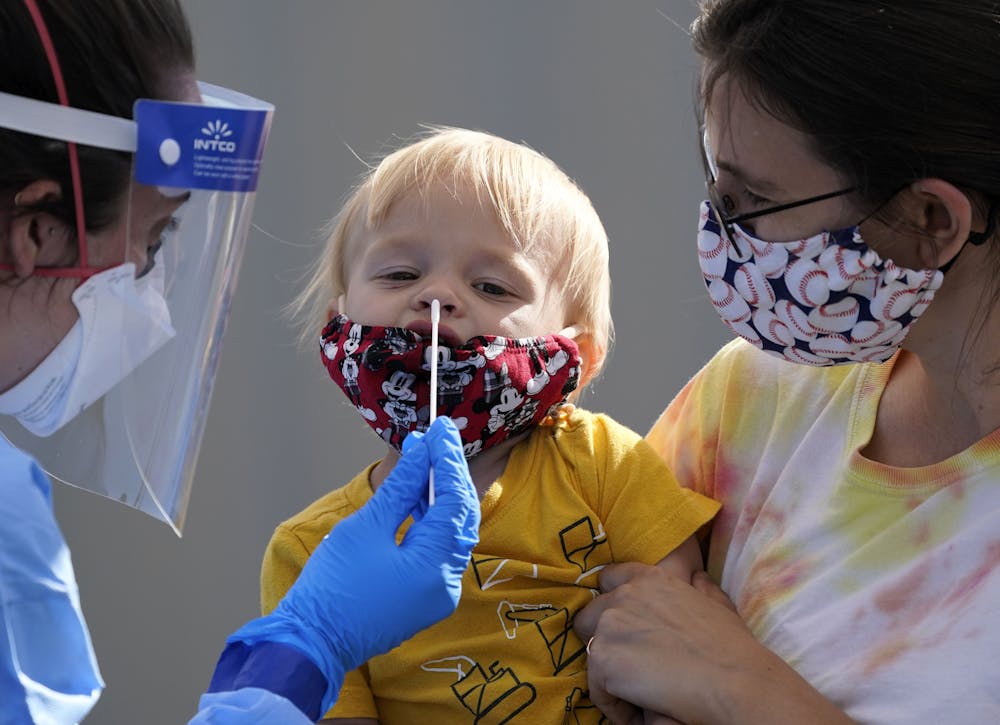
Young children are extremely unlikely to die from COVID-19.AP Photo/Elaine Thompson
Anecdotal evidence is…anecdotal
This problem goes beyond coronavirus coverage.
Another common tactic in the news business is the “anecdotal lead” – the short story that starts a news article or TV news broadcast, meant to grab attention. For example, one widely reported anecdote during the anti-racism protests following the police death of George Floyd was a store owner in Santa Monica, California, who protected his liquor store from looting in June by standing out front with an assault rifle.
Be wary of such opening anecdotes.
The Santa Monica snapshot, while true, is not indicative of how unrest across the nation is playing out. Most protests are peaceful, and when looting breaks out business owners generally leave armed defense to the police. Some press charges against those who damage their property. Other small business owners have fed, protected and joined peaceful protesters.
Many small business owners, like Oji Abbott of Washington, D.C., supported recent anti-racism protests.Brendan Smialowski / AFP via Getty Images
All those stories are told in the media, too. Yet Brian Dunning, executive director of Skeptoid Media, which produces a podcast dedicated to debunking bad science, said the opening anecdote is usually what readers and viewers remember from a news story – not so much the bigger picture it is supposed to convey.
The human brain is “hard-wired to think anecdotally,” said Dunning in a recent interview with a group of journalism educators.
Science backs this up. Research into cognitive processing finds that people consume information constantly, and their brains eventually get so full that only a few scant details can be recalled.
“So most news story content is never adequately processed and quickly forgotten,” write Stanely J. Baran and Dennis K. Davis in a primer on mass communication. “Even when we do make a more conscious effort to learn from news, we often lack the information necessary to make in-depth interpretations of content.”
The big pandemic puzzle
Despite the foibles of human memory, journalists still gravitate toward “the intriguing case report” and the “exemplar-laden account,” explain researchers Dolf Zillman and Hans Bernrd Brosius in their 2000 book “Exemplification in Communication.”
There’s a simple reason: It sells.
“Journalism dedicated to unexemplified, abstract accounts of phenomena, no matter how reliable and effectively informative, has rarely, if ever, been considered a winning formula,” say Zillman and Brosius.
[Deep knowledge, daily.Sign up for The Conversation’s newsletter.]
The real-person story is not useless. It can help people understand today’s complicated world of deadly pandemics, civil unrest and economic devastation.
But examples are only part of a bigger picture that may well be abstract, nuanced and ever-changing.
The wise news consumer will consider each example as just one piece of the pandemic puzzle as they make daily decisions to keep themselves healthy and their families safe.
Thomas J. Hrach, Associate Professor, Department of Journalism and Strategic Media, University of Memphis
This article is republished from The Conversation under a Creative Commons license. Read the original article.







 Thomas J. Hrach, University of Memphis
With COVID-19, a news story that may be 100% accurate can still unintentionally mislead readers about the greatest threats of the pandemic. The unintended outcome results from a lesson taught to every journalism student: Use “real people” to “humanize” the news.
The “real person” in COVID-19 stories may be a mom concerned about her child getting sick in the classroom, used as an example in an article about schools reopening. It may be the the family member of a person who died from COVID-19, who gives a moving account for a story about the virus’s effects on young adults.
News is about people, so it makes sense to highlight real-life stories. Viewers and readers relate more to personal tales than they do to dry statistics.
But one person’s experience is, well, one person’s experience. Media studies research suggests readers should not be unduly swayed by one person’s tale of woe – or joy – because examples don’t necessarily represent the whole.
Thomas J. Hrach, University of Memphis
With COVID-19, a news story that may be 100% accurate can still unintentionally mislead readers about the greatest threats of the pandemic. The unintended outcome results from a lesson taught to every journalism student: Use “real people” to “humanize” the news.
The “real person” in COVID-19 stories may be a mom concerned about her child getting sick in the classroom, used as an example in an article about schools reopening. It may be the the family member of a person who died from COVID-19, who gives a moving account for a story about the virus’s effects on young adults.
News is about people, so it makes sense to highlight real-life stories. Viewers and readers relate more to personal tales than they do to dry statistics.
But one person’s experience is, well, one person’s experience. Media studies research suggests readers should not be unduly swayed by one person’s tale of woe – or joy – because examples don’t necessarily represent the whole.