




The creator industry is maturing with its own middle class emerging. The Creator Economy Report highlighted that over the last year, 51.5% of creators grew their earnings. Over half of the surveyed bloggers also reported receiving stable income from multiple sources.
This signals that being a creator isn’t an unrealistic dream anymore. It can become an actual career path.
As creator ad spend is projected to reach $43.9B in the U.S. alone, more journalists and reporters are also considering going independent. In addition, 81% of the younger generation (ages 13-17) get news and information from influencers. This creates many risks for traditional media.
Several outlets have already adjusted to these changes by creating their own creator networks to appeal more to younger audiences. At the same time, some platforms, like Puck, reinvent the approach to journalism altogether.
What is the “creator middle class”?
The creator middle class is still a broad term. The report defines it as people who earn between $10,000 and $100,000+ annually with social media, with 45.6% of creators making $10K-$100K and 5.7% earning 100K+.
In terms of follower size, the creator middle class ranges from 10,000 to half a million subscribers. Yet, as the authors of the research put it, the middle class isn’t defined by follower count, but by “financial sustainability.”
While content creation shows signs of turning into an actual career, the majority of creators spend much less time on it than they would in a typical job. 37% of bloggers only dedicate 5-10 hours per week, while only 8% put in 20-40 weekly hours.
This creates more opportunities for those willing to invest more time, including journalists already working in newsrooms.
How creators make money in 2026
The report highlights that diversified revenue streams are one of the key elements that contributed to the creation of the creator middle class.
As there is no overreliance on one source of income, content creation becomes more sustainable. Revenue from advertising platforms is the top income source (21.6%), followed by creator payouts (13.3%) and brand partnerships (12.7%). Passive income from merch sales and affiliate marketing combined accounts for another 21.2% of income.
Paid communities are also gaining popularity as another monetization tactic, with over 40% of bloggers planning to build one in 2026.
Why this is important
Before, the creator industry was either about big celebrities or people who treated social media as a hobby. Yet, the creator economy trends are changing. More bloggers see real career potential in different online platforms.
In addition, the demand for creators is growing. Creator-related ad spend in the U.S. alone is projected to reach $43.9B, an 18% growth from 2025.
This is also a good sign for businesses because these middle-class creators tend to treat their social media more seriously than those who see it purely as a hobby. And at the same time, collaborating with them is much more affordable than doing top-tier influencer outreach.
As for media publishers, this opens another window of opportunity. Most creators struggle with visibility and get fewer than 1,000 views (76% on TikTok and 59.1% of those who post long-form videos on YouTube).
Yet, media outlets already have the visibility. What they might need is exploring new opportunities to build communities around their brand and give their journalists more freedom to test new directions.
Some publishers understand this
Many publishers, including CNN, Yahoo, The Washington Post, and Future, are already actively building their own creator networks. In this collaboration, media outlets are responsible for credibility and curation while creators bring personality and reach.
The Washington Post approached this matter from two angles. They’ve created an internal social-first project called Washington Post Universe and the WP Creator Network, where they partner with external creators.
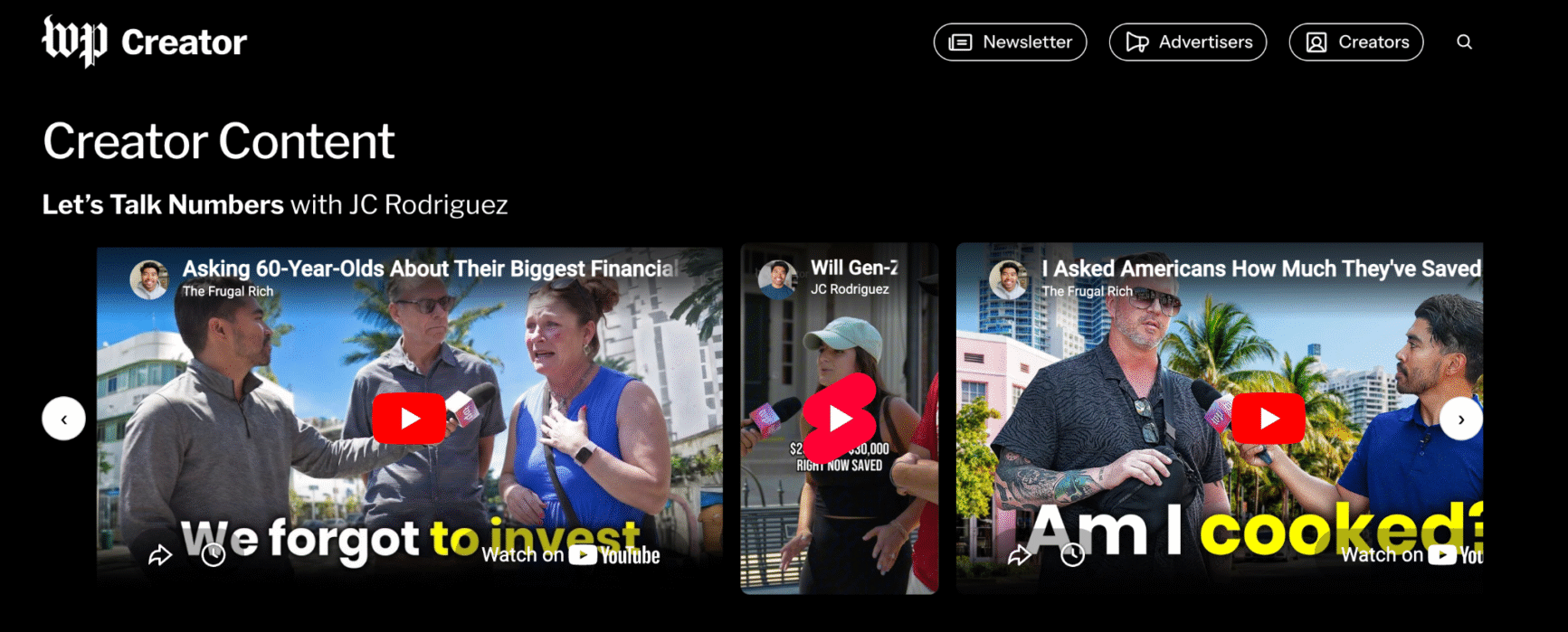
A screenshot from the WP Creator Network website
Both initiatives are meant to attract younger audiences through formats and collaborations that go beyond classic journalism. The Creator Network project is still experimental and undergoing some changes. The latest update is that creators retain their IP and get paid for video series (six to 10 videos).
What publishers can learn from this
The growth of the creator economy might be seen as a threat by media publishers. However, apart from potential risks, like staff retention and the outlet’s visibility in the new age, there are also several opportunities. In fact, the media can learn from creators.
Communities
Instead of optimizing for reach alone, publishers can also explore community building. A loyal audience is what creators successfully monetize, and what media outlets can leverage better.
Traditional journalism has always relied on some form of subscription or fee. Yet, the current trends make it harder to sustain. Only 17% of Americans pay for news. At the same time, we’re seeing a rise in paid communities. Substack reached 20 million monthly active subscribers, and Patreon surpassed 25 million paid memberships.
So, while the current subscription model might not be working as well as expected for many outlets, there is a demand. Still, this isn’t a demand for information alone, but for a community where users feel understood. This is where creators tend to “outplay” traditional media. However, the audience strategy shift can change this.
Diversified income
The Creator Economy Report also mentions that diversified revenue is one of the elements that has contributed to making blogging more sustainable. This insight can create another opportunity for publishers.
Traditional media can consider additional content creator income streams beyond display advertising and subscriptions.
As creator-related ad spend is growing worldwide, media outlets can position themselves as a more reliable alternative to individual creators for that same ad budget. Yet, for this to be effective, the formats and angles have to adjust.
How you can build a creator middle class in your newsroom
Journalists going independent is nothing new in the industry. This has happened before. But now that the creator business model is becoming more stable, it’s generally easier, especially for journalists who already have some media visibility.
One of the latest popular examples of this was Dave Jorgenson, “The Washington Post TikTok guy,” leaving to build his own media company. He announced this with an ironic video that started with “Dear Jeff Bezos…”
As he later shared in his Nieman Lab interview, he felt like he’d “hit a ceiling.”
Still, while being a creator seems safer than before, newsrooms don’t have to lose their teams to independent media projects. One solution is to provide staff with the infrastructure to grow communities and build their audience under the outlet’s brand.
Media outlets can give journalist-creators more than just institutional credibility. It can become a platform with resources and knowledge that helps them improve their skills and gain more visibility. This, in turn, will attract new audiences for the outlet.
This is how the media industry is changing
Puck is a great example of a modern approach. They describe their positioning as “journalism owned and operated by the journalists themselves.”
They don’t hire reporters in the classic sense. They’ve created a cooperative of top-tier journalists who write exclusive newsletters that they then offer in a bundle to their subscribers. This model isn’t about attracting massive web traffic but about building a closer connection with the audience.
In addition to their salaries, journalists also receive bonuses for new and retained subscribers. Besides, everyone from writers and editors to data analysts gets to share the equity in the company.
Sarah Personette, CEO of Puck, often says that journalists were the original influencers. While they work with some of the most well-known reporters who don’t represent the “creator middle class,” their approach is future-oriented. They put creators at the heart of their business.
This is the model outlets can replicate at many levels, not just with top-tier writers.
Attracting external creators to the newsroom might be a tough and expensive task. That’s why many journalists advocate for creating their own communities and growing their own audiences. A newsroom that encourages this proactive social media integration will be better positioned than those that rely on a traditional model alone.
Content creation isn’t just a hobby anymore
Being a creator isn’t just a “fun thing to do” anymore. The industry is growing and becoming more grounded. That’s why publishers have to adjust as well. This isn’t some future possibility. Creator economy growth is real.
As social media shifts from a hobby to an actual career opportunity, bloggers want to improve their skills to deliver better content, grow their earnings, and build a more serious creator business model.
Not only do they plan to launch their own paid communities and products, 22.4% of them also want to invest in video production skills, 20% in branding, and 14.3% in storytelling.
This is where newsrooms can offer resources and brand credibility, while gaining access to new audiences and future-proofing their business. While there are many approaches a media outlet can take, the one that’s already working in the industry is putting creators at the center of the business.