




According to the American economist Thomas Sowell; “The first lesson of economics is scarcity: there is never enough of anything to fully satisfy all those who want it.”
Once a unique proprietary product or service becomes commoditized it loses its scarcity in an over competing market-place and its distinct advantages become interchangeable with the products its rival offers. This leads to commodity-based pricing which results in much lower profit margins…
…sound familiar?
As an industry, we commoditized content first helped by the rise of technology and connected devices we’ve made content ubiquitous, available to anyone anywhere with an internet connection and what is scarce today is the supply of attention.
The second part of the digital publisher ecosystem to get commoditized was audience attention, by way of packaging up user page views, sessions times and clicks and selling them off to the lowest bidder.
This short-sighted drive for attention lead businesses to gamify their content to encourage more eyeballs and more clicks to feed their revenue models which Gideon Lichfield, Editor-in-chief at MIT Technology Review calls “Toxic and responsible for garbage content, fake news and the excessive power of giant social media platforms.” – not to mention the rise in click farms and digital ad-fraud.
The latest 2019 Time Spent with Media report from eMarketer suggests that on average Americans spend over twelve hours a day engaging with media. Drilling down into the report you’ll see that traditional newspapers and magazines present a worryingly low figure while digital makes up over half of their entire spent consuming content. 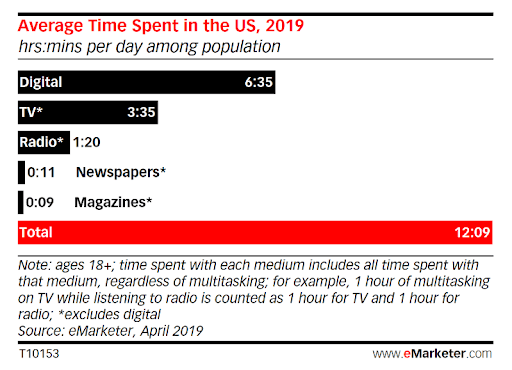 In a digital environment, it’s fair to say that every piece of content competes against all the others and competition is fierce. In a world with information surplus and attention scarcity this competition Tim Wu, Author of The Attention Merchants writes “will naturally run to the bottom: attention will almost invariably gravitate to the most garish, lurid, outrageous alternative, whatever stimulus may more likely engage our ‘automatic attention’.”
The problem is attention doesn’t scale and as Warren Buffet puts it. “Everybody has just got two eyeballs, and they’ve got X hours of discretionary time.”
A recent report from the Reuters Institute for the Study in Journalism found that of all the people surveyed across more than thirty countries 32% of respondents were actively avoiding the news. You could argue that as user engagement is in decline, that as a publisher you may find yourself in an attention recession and if that’s the case, how do you combat this to ensure economic stability and long-term sustainable growth.
If scarcity is the issue and the de-commoditization of attention the goal then how, as a publisher do you reverse this calamitous economic state.
The truth is you cannot turn the tide on an entire ecosystem levied so heavily on views and clicks over-night, but as an individual publisher, you can buck the trend and invest in a quality product, quality content and hold a longer term view when it comes to audience engagement.
In a digital environment, it’s fair to say that every piece of content competes against all the others and competition is fierce. In a world with information surplus and attention scarcity this competition Tim Wu, Author of The Attention Merchants writes “will naturally run to the bottom: attention will almost invariably gravitate to the most garish, lurid, outrageous alternative, whatever stimulus may more likely engage our ‘automatic attention’.”
The problem is attention doesn’t scale and as Warren Buffet puts it. “Everybody has just got two eyeballs, and they’ve got X hours of discretionary time.”
A recent report from the Reuters Institute for the Study in Journalism found that of all the people surveyed across more than thirty countries 32% of respondents were actively avoiding the news. You could argue that as user engagement is in decline, that as a publisher you may find yourself in an attention recession and if that’s the case, how do you combat this to ensure economic stability and long-term sustainable growth.
If scarcity is the issue and the de-commoditization of attention the goal then how, as a publisher do you reverse this calamitous economic state.
The truth is you cannot turn the tide on an entire ecosystem levied so heavily on views and clicks over-night, but as an individual publisher, you can buck the trend and invest in a quality product, quality content and hold a longer term view when it comes to audience engagement.
In a digital environment, it’s fair to say that every piece of content competes against all the others and competition is fierce. In a world with information surplus and attention scarcity this competition Tim Wu, Author of The Attention Merchants writes “will naturally run to the bottom: attention will almost invariably gravitate to the most garish, lurid, outrageous alternative, whatever stimulus may more likely engage our ‘automatic attention’.”
The problem is attention doesn’t scale and as Warren Buffet puts it. “Everybody has just got two eyeballs, and they’ve got X hours of discretionary time.”
A recent report from the Reuters Institute for the Study in Journalism found that of all the people surveyed across more than thirty countries 32% of respondents were actively avoiding the news. You could argue that as user engagement is in decline, that as a publisher you may find yourself in an attention recession and if that’s the case, how do you combat this to ensure economic stability and long-term sustainable growth.
If scarcity is the issue and the de-commoditization of attention the goal then how, as a publisher do you reverse this calamitous economic state.
The truth is you cannot turn the tide on an entire ecosystem levied so heavily on views and clicks over-night, but as an individual publisher, you can buck the trend and invest in a quality product, quality content and hold a longer term view when it comes to audience engagement.